The seller says the airbag light is "just a sensor" and will be fixed after you pay the booking amount. That is not a diagnosis. On a used car, a warning from the supplementary restraint system deserves its own inspection before you negotiate the price, because the question is not whether the car drives today. It is whether its protection systems will work in a crash.
Watch the start-up check, not just the test drive
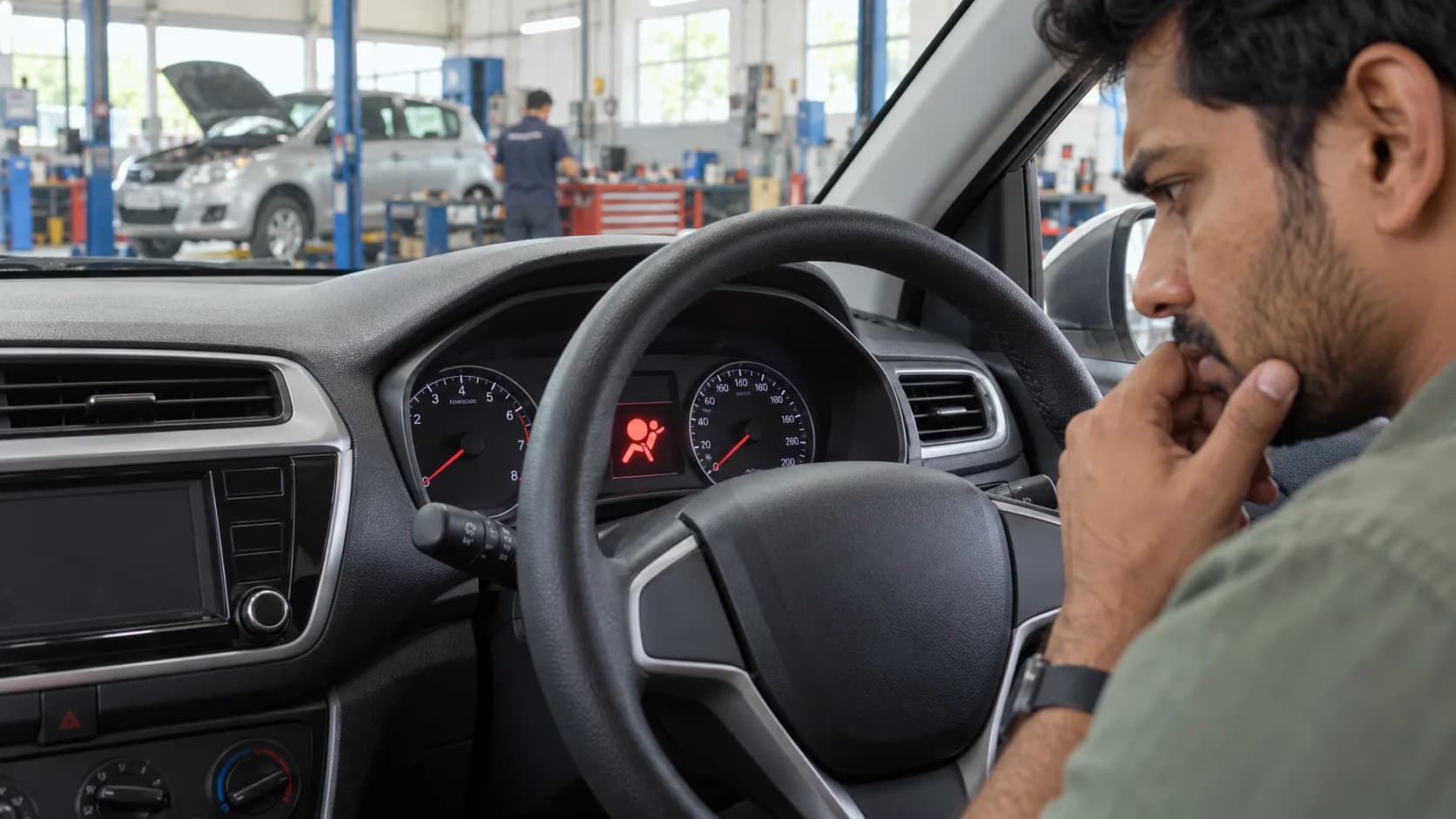
Ask the seller to leave the car switched off until you are beside it. Turn the ignition on and watch the cluster before starting. The airbag or SRS indicator should normally illuminate briefly as a self-check and then go out, according to the exact car's manual. Hyundai's owner guidance, for example, describes a short illumination followed by extinction and says a light that remains on needs inspection. The timing and appearance vary between cars, so check that model's handbook rather than memorising one universal number.
Three observations should stop the purchase process until clarified: the lamp never appears during its expected self-check, it stays lit after start-up, or it comes back while driving. A light that does not appear at all is not reassuring. It could mean a display fault, a different cluster arrangement, or a tampered indicator. You cannot tell which from the driver's seat. Hyundai's SRS manual section treats both failure to light and failure to extinguish as reasons for professional inspection.
A cleared warning is not a completed repair
A seller may show you a dashboard with no lamp and declare the matter closed. Ask what was repaired and request the job card. The diagnostic system should be scanned with equipment capable of reading SRS modules, not merely a basic engine-code reader. A competent technician should identify current and stored faults, inspect the relevant component and wiring under the manufacturer's procedure, and confirm that the system completes its check afterward. Clearing a code without resolving its cause is not proof that the system is sound.
There are innocent-looking reasons an SRS fault can appear, including connector or sensor problems, but they cannot be assumed away. A previous crash may have deployed an airbag or seat-belt pretensioner. A replacement part may be missing, incorrect or poorly installed. The US safety regulator NHTSA warns used-car buyers about substandard replacement inflators and urges them to establish the car's history and genuine replacement parts. That warning is about the safety mechanism, not a claim that US rules apply to an Indian sale.
Look for evidence of a past crash repair
Start with paperwork: insurance claim history where available, service invoices, body-shop records and any record of airbag or pretensioner replacement. Do not rely solely on a verbal "no accident" assurance. Inspect panel gaps, paint variation and signs of work around the steering wheel, dashboard, pillars and seats. Such signs are clues, not a verdict; normal maintenance or cosmetic repair can also leave marks. An independent inspection is especially valuable when a vehicle has had front-end, side or interior repairs.
Check the seat belts as well. Make sure each belt retracts, latches and releases normally. Look for damaged webbing and obvious replacement inconsistencies. Modern restraint systems can link airbags, sensors and belt pretensioners, so a belt problem should not be dismissed as a minor upholstery issue. Do not remove trim or probe connectors yourself. Hyundai's SRS-care instructions explicitly caution against owner servicing or tampering with SRS components.
What to ask the inspector
Tell an authorised service centre or a credible independent specialist that you are deciding whether to buy the car. Ask for a written answer to specific questions: does the SRS self-check behave as the manufacturer's manual specifies; are there active or stored SRS trouble codes; is there evidence of deployment; do fitted airbag and pretensioner parts match the car; and what repairs, if any, are required? If the workshop cannot verify a repair history, it should say so. A generic "all okay" note after a short drive is much less useful.
Have the inspection done before the final payment, ideally with the seller's consent and the car's identifying details on the report. If the seller refuses an SRS scan after a warning lamp has appeared, that refusal is information about the transaction. You can move on without having to prove exactly what is wrong. If a fault is found and repair is feasible, obtain a documented estimate from a qualified workshop and decide only after the repair and a subsequent verification.
Separate a recall from a fault diagnosis
Before viewing the car, record its vehicle identification number from the documents and verify that it matches the stamped or displayed identifiers on the vehicle. Ask the maker's service network to check outstanding safety campaigns for that exact vehicle and market. An open recall, if there is one, is not the same as a current SRS fault code, and a clean recall record does not prove the system has never been damaged. Both checks answer different questions. Be wary of a report that uses a different registration or VIN from the vehicle being sold.
If the seller produces an invoice for an earlier airbag repair, read the part description and date. Did the work include an airbag module, control unit, sensors, wiring or a seat-belt pretensioner? Was there a post-repair scan? An invoice may show money was spent without showing that every affected part was checked. Have the inspecting workshop compare the invoice with the car's present condition, especially if the work followed a collision.
What a short drive can and cannot show
During a safe test drive, note whether the SRS lamp reappears over bumps or after seat adjustments, but do not move seats simply to provoke a fault while driving. A warning that comes and goes is still worth diagnosing. Many restraint faults cannot be detected by how the car steers or brakes, so a smooth drive is no substitute for a scan. Conversely, an SRS fault does not automatically explain unrelated engine or chassis issues; keep the broader used-car inspection separate.
If a technician says the fault is merely a loose connector, ask for the precise code and the approved repair method. SRS wiring and connectors are safety-critical. A temporary bypass, resistor or taped joint may silence a warning without restoring protection. The only useful outcome is a repair carried out to the manufacturer's procedure and verified afterward.
Do not negotiate safety as if it were a cosmetic defect
A scratch can be priced into a used-car deal. An unresolved restraint-system warning is different because the potential failure may become visible only when protection is needed. The absence of a lamp after one restart does not erase a documented intermittent fault. Equally, a dashboard light by itself does not prove every airbag is missing. The fair response is verification, not panic or guesswork.
Before booking a used car, photograph the cluster at ignition-on and after start, collect the repair records, and arrange the SRS-specific inspection. If the car passes, keep the report with the purchase documents. If it does not, insist on a proper repair with genuine parts and a clean post-repair check, or choose another vehicle. The seller's promise to "sort it later" is not a safety system.