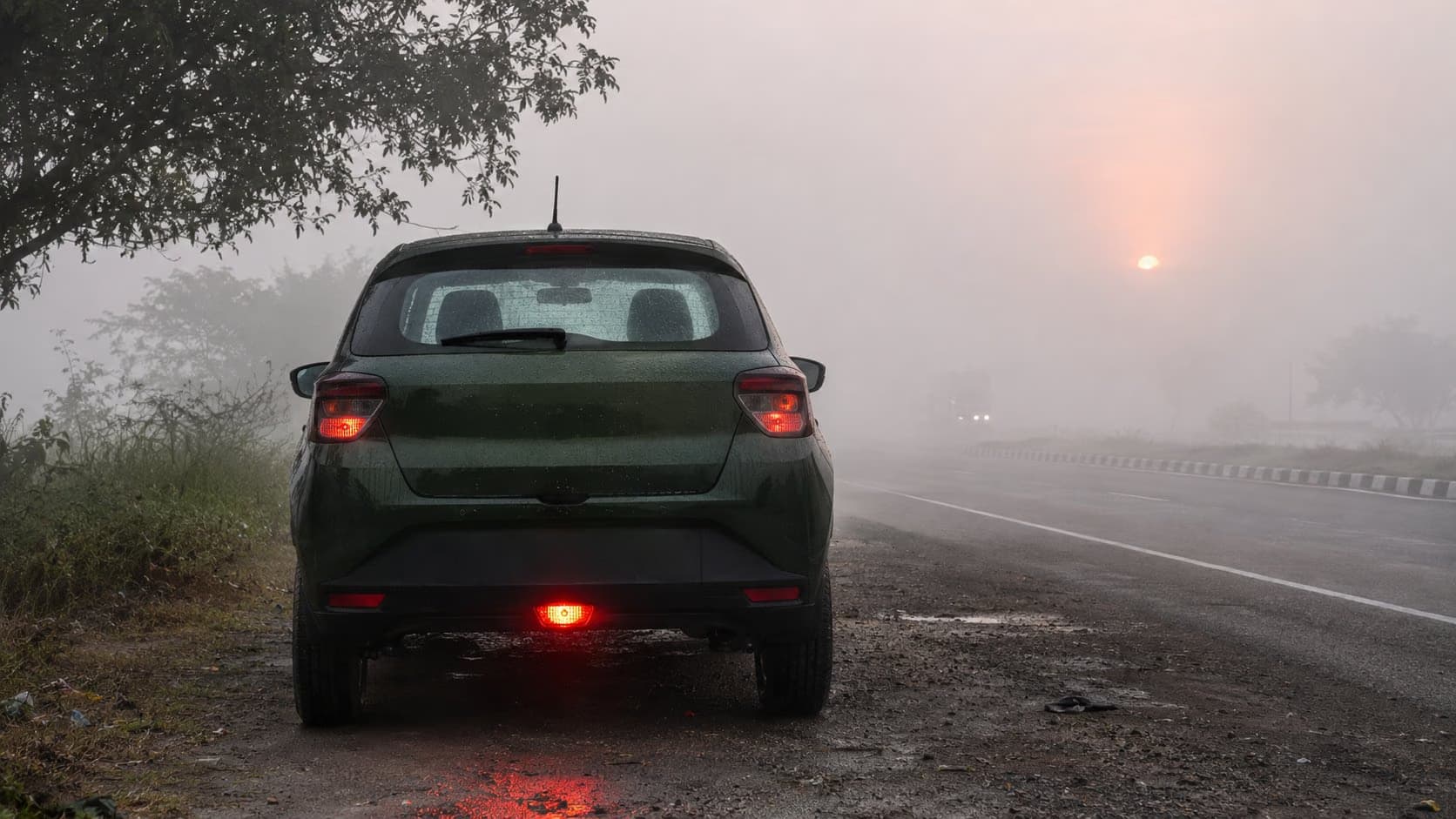
You can recognise a rear fog lamp from well behind a car: it is a very bright red light, often on only one side of the lower rear bumper. That conspicuousness is its purpose. In dense fog or heavy rain, it helps a following driver notice that your car is there. Once the air clears, the same brightness can distract a driver close behind. The useful habit is to switch it on for genuinely poor visibility and remember to switch it off when you no longer need it.
Do not assume that every red lamp at the back of a car has the same job. Tail lamps show a vehicle’s presence in normal darkness. Brake lamps show that the driver is slowing. A rear fog lamp is an extra visibility aid for bad conditions; it is not a brake lamp or a substitute for one. Volvo’s owner guidance describes the rear fog light as a way to warn traffic behind the car of its presence in poor weather and low visibility.
When it helps
Use the rear fog lamp when fog, heavy rain or similar conditions make it hard for following traffic to see your vehicle at a useful distance, subject to the instructions for your exact car and local rules. This is a judgement about visibility, not simply a judgement about whether it is raining. A brief shower in daylight may not justify it; dense fog on a rural road may. In both cases, reduce speed and leave more following and braking space. A lamp does not restore the road distance you have lost.
Many cars make you activate the rear fog lamp manually. Look for the dedicated symbol on the switch and dashboard and confirm in your owner’s manual what that symbol means. On some cars the front and rear fog controls are separate, even though both use a lamp icon with lines. If you are unsure which one you pressed, stop somewhere safe and check before driving in poor visibility. Fumbling through an unfamiliar lighting menu while moving defeats the point of a safety aid.
Why the switch-off moment matters
As soon as visibility improves enough that ordinary tail lamps are clear to following traffic, turn the rear fog lamp off. It can be uncomfortably bright at close range and may make it harder for another driver to read your brake lights. A car left with its rear fog lamp on through a clear city street is using a severe-weather signal where it no longer helps. Check the instrument-cluster indicator after leaving a fog bank or rainstorm; some drivers forget because they cannot see the back of their own car.
Visibility can change along a route. A highway cutting may be foggy while the open road beyond it is clear. You may need to switch the lamp on and then off more than once. Make that part of the same mental check as adjusting your speed and distance. If the car resets its fog-lamp setting when you turn it off, verify the controls before the next early-morning drive instead of assuming yesterday’s state remains.
Rear fog versus front fog
Front fog lamps, where fitted, aim to improve the road illumination or the car’s visibility from ahead in particular weather. The rear fog lamp is for drivers approaching from behind. One does not automatically mean the other is present. Many recent cars have changed front-light designs, and equipment can vary between variants. Check the actual car and variant rather than a generic feature list. If your car has no rear fog lamp, do not assume that an empty switch position is a malfunction.
Also do not confuse a single rear fog lamp with a failed tail lamp. Some vehicles are designed with one rear fog lamp and a separate reverse lamp on the opposite side. The arrangement can look asymmetrical from behind. Your owner’s manual or a safe stationary light check will tell you what is intended. If an ordinary tail lamp or brake lamp has failed, have it repaired; a working fog lamp does not make that failure harmless.
Why hazard lights are not the same thing
Hazard lamps flash all the turn indicators at once. They are a different signal from a steady rear fog light and can make your intended turn less clear to other road users if left flashing while you drive. Do not treat the hazard switch as a generic substitute for choosing the proper lights for weather conditions. Follow the guidance in your vehicle manual and the rules in the place you drive. If you are stopped because of a breakdown, the signalling situation is different from moving slowly in fog.
Low beam, a clean windscreen and appropriate speed are more important than trying to illuminate the whole road with every available lamp. High beam can reflect back from dense fog and make the view ahead worse. Keep the glass, mirrors and lamp lenses clean; grime and condensation reduce visibility regardless of which switches are on. If the road ahead becomes too hard to read, find a safe place to leave the traffic flow rather than pressing on at the same speed.
A quick stationary test before winter driving
With the vehicle safely parked, learn how the rear fog switch works. Turn on the required main lighting if your manual says the fog lamp depends on it, activate the rear fog lamp, and ask someone to confirm which light illuminates. Look at the dashboard symbol at the same time. Then turn the lamp off and make sure the symbol disappears. Do not stare directly into the bright lamp. This five-minute check is useful when a car is new to you or when you have changed vehicles.
Read the lighting section of your exact owner’s manual. Volvo’s manual provides one example of the purpose and control, but switch logic differs across brands. Some cars require dipped headlights or parking lamps before the rear fog lamp will operate. Some put the control on a stalk, others on a panel or screen. A quick check at home is easier than learning all this while visibility is already poor.
What if a following driver is very close?
Do not use the fog lamp to punish someone for tailgating. Maintain a steady, appropriate speed for the conditions, increase your gap to the vehicle ahead so you have more time to brake gently, and let the following driver pass when safe. If the fog remains dense, the lamp may still be needed for visibility; if it has cleared, switch it off. The decision should follow the weather and traffic visibility, not irritation with another driver.
A rear fog lamp is a simple device, but using it well requires attention to changing conditions. Turn it on when following drivers genuinely need help seeing you. Turn it off when they do not. If you are unsure whether your car has one, find the answer in the owner’s manual before the next foggy morning.
Sources: Volvo owner guidance on rear fog lights; Indian Automotive Industry Standard AIS-012 definition and requirements for rear fog lamps. Check your vehicle manual and applicable local rules.