The car locks when you touch its handle and starts with the fob in your pocket. That is genuinely convenient, but it changes where you should keep the key at home. With some passive keyless systems, a thief can use relay equipment to make the car believe a nearby fob is present even when it is inside the house. The sensible response is neither panic nor a gadget spree. It is to establish which technology your car uses and add protections that address that exact risk.
A button-operated remote and a passive keyless-entry system are not identical. If you must press the fob to unlock the car, the passive relay scenario described here may not apply in the same way. Check the owner's manual or ask the manufacturer's service team rather than assuming every remote key has the same exposure.
How the relay method works
The vehicle sends or receives a short-range challenge, and the fob responds when it appears to be nearby. Relay equipment can extend that conversation between the car and a distant key. Warwickshire Police's guidance explains the mechanism and distinguishes passive entry from a remote that requires a button press. A successful relay does not mean the thief guessed the key's code; it means the car was fooled about the key's distance.
Other theft methods also exist, including stolen keys and attacks on different vehicle systems. A Faraday pouch is a layer for the passive key signal, not a universal anti-theft guarantee. That distinction matters when evaluating an accessory advertisement claiming to make any vehicle theft-proof.
Move the keys away from the perimeter
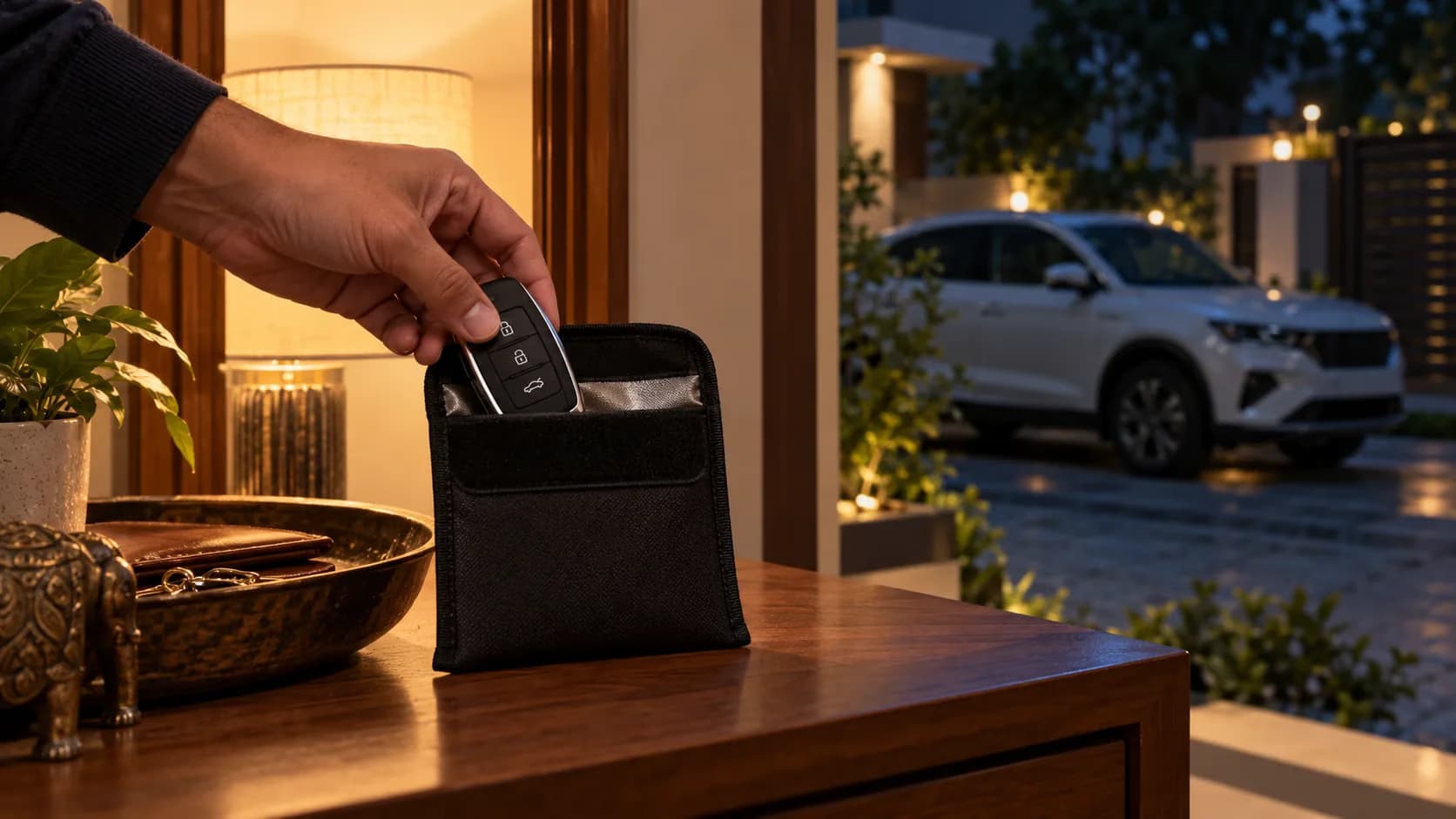
Do not leave the primary and spare fobs on a table beside the front door or a window, especially if the car is parked close outside. Store both farther inside the home. Thatcham Research's security advice recommends keeping fobs away from doors and windows, and notes that some newer fobs sleep when stationary. Ask the dealer whether your exact fob has a motion-sleep feature or a way to disable its wireless signal while not in use.
Make the location practical enough to use every evening. A pouch kept in a drawer that nobody remembers is not much protection. Keep the spare in a similarly protected place; a neglected spare near the car can defeat an otherwise careful routine.
Test a signal-blocking pouch
A correctly working Faraday pouch should prevent the car from detecting the key while it is fully enclosed. With the car safely parked, put the fob inside, close the pouch and try the door handle without another key nearby. If it unlocks, check whether the pouch is closed correctly or has worn out. Warwickshire Police specifically recommends testing the pouch this way. Repeat occasionally, because fabric and closures deteriorate.
Be aware that some pouches have two compartments and only one is signal-blocking. Check the manufacturer's instructions. Do not try the test with a person or pet locked in the vehicle; this is a simple parked-door test, not a security experiment.
Layer physical and digital security
A visible steering-wheel lock or secure parking barrier can add delay if someone gets past the electronic layer. Whether a tracker is worth paying for depends on the car, insurance terms and recovery service. Do not assume an app's "find my car" feature is a theft-recovery product or that it keeps working after a thief tampers with the vehicle. Ask insurers and installers for the actual service terms before buying.
Check that the car really locked before walking away. Radio interference or simple distraction can leave a door unsecured without a relay attack. A glance at the mirrors or indicators is not always conclusive; pull the handle after locking where the vehicle design permits. Keep valuables out of sight, and secure the home keys themselves.
What to ask when buying a car
In a showroom, ask whether the variant has passive entry or only a remote-button unlock, whether the fob sleeps, whether passive entry can be disabled, and whether a software security update is available. Get model-specific answers. A higher trim can have a different key system from the basic version, so the brochure's single "smart key" line is inadequate.
For a used car, confirm that all physical keys are present. If a key is missing, ask an authorised service centre what it takes to remove old key authorisation and issue replacements. Do not rely on the seller's word that a lost key "cannot work now." The used-car digital-app handover is separate from the physical key inventory and deserves its own check.
What not to infer from a theft video
A clip of someone opening one model does not show that every car with push-button start has the same weakness. Manufacturers use different key protocols and mitigations. Conversely, the absence of a theft story for your model is not proof of immunity. The practical steps are low-drama: identify the system, store both fobs sensibly, test any pouch and use another security layer where your parking situation warrants it.
Make the mitigation fit the car
Some fobs can be put into a sleep state or have their passive signal disabled using a model-specific button sequence. Others have motion detection built in, and some do neither. Do not copy a sequence from a different brand and accidentally disable a feature you need. Ask the manufacturer or read the manual. After any change, confirm that the mechanical emergency entry and starting procedure are understood by the drivers in the household.
When testing a pouch, remove both primary and spare fobs from the car's detection range. Otherwise the door may unlock because the unprotected spare is nearby, leading you to blame a working pouch. Try the test with each key separately. Check the pouch periodically, especially if its lining or closure is worn. A Faraday pouch does not replace physical security if somebody can simply pick up the keys.
Parking and insurance
Where you park changes the risk. A car on a driveway beside the front door offers a different opportunity from one in a locked garage farther away. Lighting, a gate and a visible mechanical lock can add friction without relying on electronics. Ask your insurer whether it has specific security-device requirements or discounts, but do not buy a tracker based solely on a promised premium reduction. Understand subscription, recovery and battery-backup terms first.
There is also a difference between preventing a relay and responding after a key has gone missing. A pouch protects a fob you still possess; it does not erase a lost key from the car. Ask the authorised service centre whether the missing fob can be deauthorised and what replacement procedure is required. Keep both remaining keys secure until the change is complete.
If you lend the car to somebody else, explain any unusual lock or sleep setting so they are not stranded. Security that routinely causes users to bypass it will not last as a habit.
If your car is stolen, contact the local police and insurer promptly, preserve footage or location data without confronting suspects and follow their instructions. Prevention is easier than trying to intervene in a theft underway.