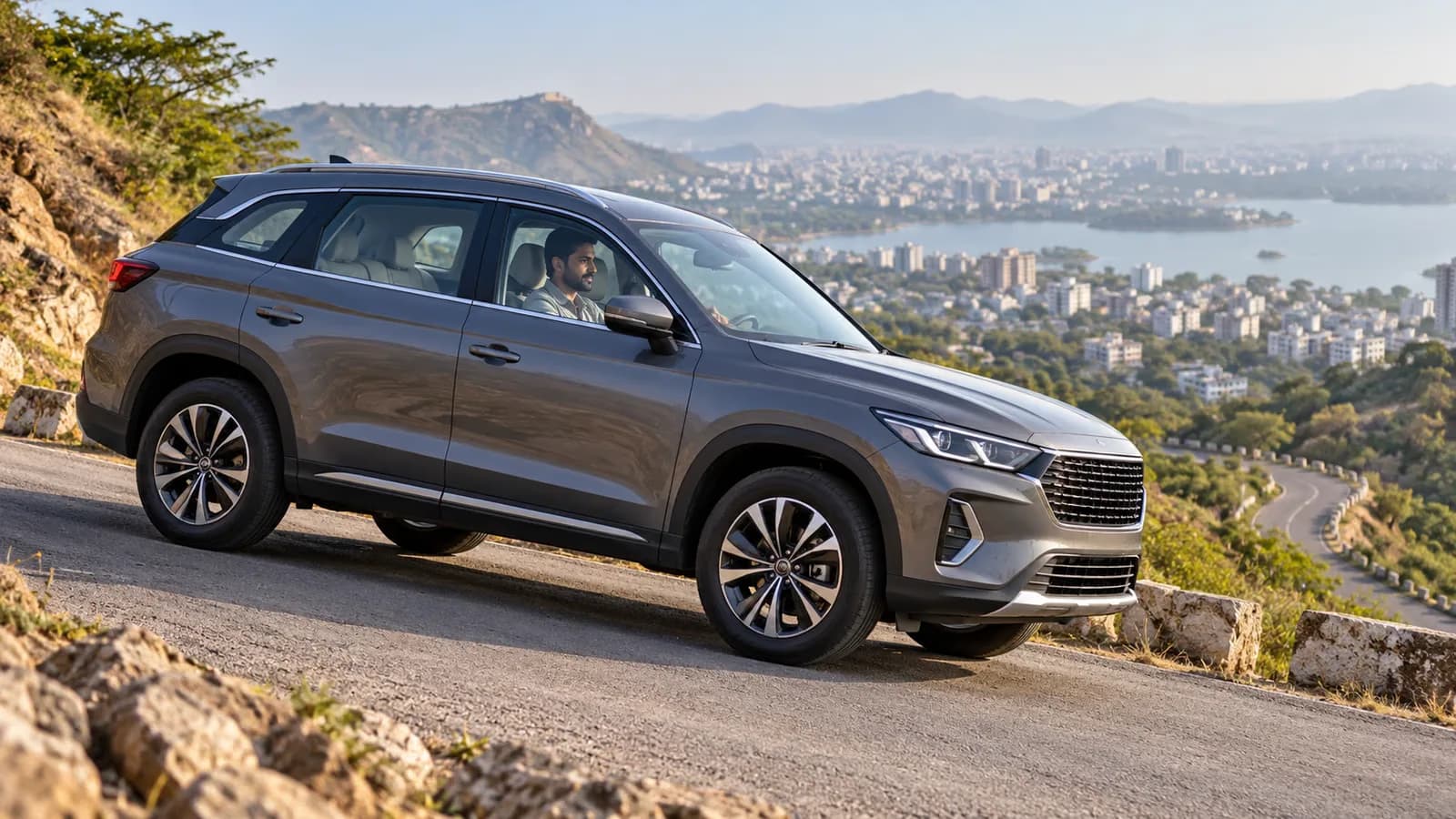
A steep parking-ramp exit and a loose downhill track are very different driving problems. Hill-start assist helps with the first: moving away from a stop without immediately rolling backwards. Hill-descent control helps with the second: managing speed while going down a slope. A car may have one, both or neither, and the names on a feature list are not a substitute for understanding how each operates.
What hill-start assist does
When you stop on an incline and lift your foot from the brake to press the accelerator, there is a brief interval when the car can roll. Hill-start assist holds braking force for a short time so you can move your foot and set off. Bosch describes hill-hold and hill-descent functions among the value-added functions built around electronic stability and braking systems. The way a manufacturer implements them, including activation threshold and hold duration, varies.
The key word is “short”. This is not a parking brake, a guarantee against rolling, or permission to balance a manual car on its clutch. If you wait too long, or if the car does not detect the conditions for activation, it may release. Hold the brake properly at a prolonged signal or on a queueing flyover. For a manual transmission, use the clutch and accelerator as taught for that car; for an automatic, follow the owner's manual rather than relying on creep alone on a steep grade.
What hill-descent control does
Hill-descent control is intended to help maintain a low, controlled speed while descending. It can use the braking system to manage individual wheel speeds and reduce the need for continuous heavy brake-pedal input on a suitable slope. It is commonly associated with SUVs and rough-road use, though the exact application varies by vehicle. The driver still chooses the route, steers, and remains responsible for the car's speed and surroundings.
There may be a switch or a menu setting, and there may be a specified speed range, drive mode or transmission setting. Some systems allow speed adjustment with pedals or steering-wheel controls. Never assume that the feature works just because an icon appears in a brochure. Read the model's manual for engagement conditions and the meaning of warning lights. Test only in a safe, open location at low speed after familiarising yourself with the controls.
The important difference
Hill-start assist acts during the transition from stationary to moving uphill. Hill-descent control acts while the vehicle is moving downhill. Neither creates tyre grip. If the tyres are worn, the road is slippery or the surface is loose, the systems cannot override the available traction. Neither replaces judgement about whether the road is passable.
A common misunderstanding is that a car with hill-start assist will also control downhill speed. It will not. Another is that hill-descent control will hold the car indefinitely when stopped. It is not a substitute for the service brake or parking brake. On a long paved mountain descent, the driver's choice of a suitable lower gear or regenerative-braking setting, where supported, remains important to control speed and manage brake heat.
How the feature feels in daily driving
On a city parking ramp, hill-start assist may be almost invisible. You release the brake and find that the car does not immediately drift back before you accelerate. On a steeper ramp the assistance can be more noticeable, but the hold time may still be brief. If you experience a small amount of movement, that does not automatically mean the system is faulty: activation can depend on slope and pedal input. The manual is the authority for that car.
Hill-descent control can feel unusual because the brakes may pulse or make operating noises as the system regulates speed. That is different from normal downhill driving. Do not discover the feature for the first time on a narrow mountain road with traffic behind you. The preferred speed or active range may be too slow for a public road and more appropriate to a low-speed unpaved descent.
Checklist for a test drive
- Confirm the exact trim has the feature. A model-wide advertisement may refer to a higher variant.
- Ask for a demonstration of the hill-start function on a safe ramp, with the salesperson explaining the release timing.
- If hill-descent control matters to you, locate its switch or menu entry and ask for the operating speed and drive-mode conditions.
- Check whether the owner's manual specifies limits for slippery surfaces, towing, tyres or system faults.
- Observe whether the instrument panel gives a clear active or unavailable indication. A vague icon is easy to misread.
- Keep tyre condition and correct inflation in mind. Electronic aids work through the tyres, not around them.
Manual versus automatic cars
Hill-start assist can be particularly welcome in a manual car because the driver must coordinate clutch engagement and accelerator input. An automatic may still roll on a steep grade; “automatic” alone does not guarantee a hill hold. Some cars also have an auto-hold feature that keeps the brakes applied at a stop until the driver requests movement. Auto-hold and hill-start assist are related in how they may use brakes, but they have different user experiences and may be separate features. Verify both by name on the variant sheet and by operation in the manual.
Bottom line
If your main concern is a steep basement ramp or stop-start traffic on a flyover, prioritise hill-start assist and a predictable parking brake. If you regularly drive steep, rough descents, investigate hill-descent control, appropriate tyres and the car's clearance and traction setup together. The feature that matters is the one that addresses your actual road, in the exact variant you are buying, with limits you understand before the drive.