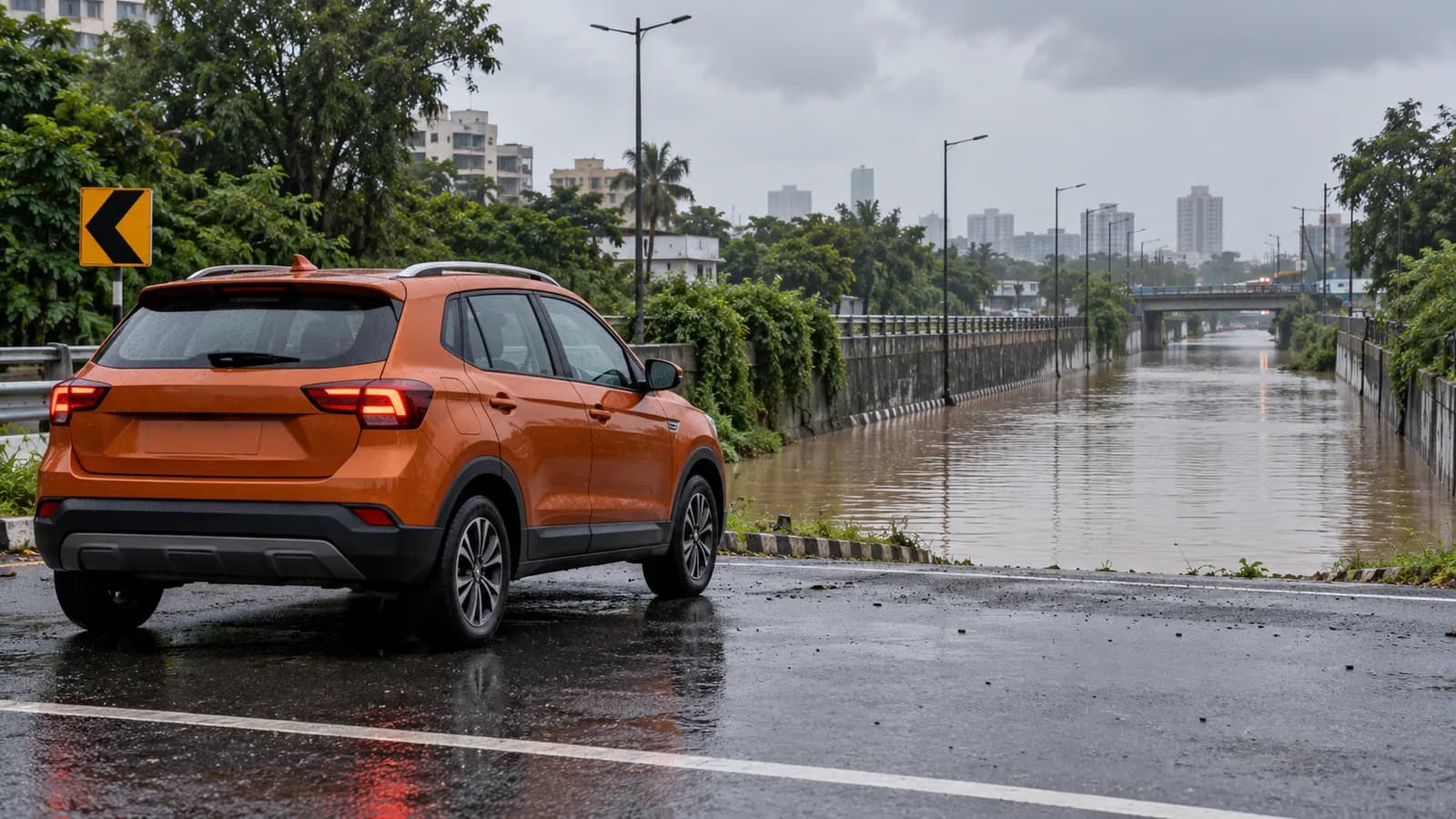
A high-riding car can make a flooded underpass look less intimidating. The problem is that you cannot see the road beneath the water, how quickly the level is rising or whether a current is crossing the route. A manufacturer's wading number, where one is published, is not a general permit to drive into any urban flood. Often the safest decision is to turn around and take another route.
What a wading specification actually means
A vehicle's stated maximum water depth is a model-specific limit under defined conditions. It may depend on water being still, the vehicle being in standard condition and a prescribed driving method. Do not apply a figure from one SUV, variant or overseas owner's manual to another car. Ford's owner-manual guidance distinguishes standing from flowing water and warns that deep, fast-moving water can cause loss of control. It also notes risks to the engine, transmission, electrical components and cabin. That source describes a specific Ford vehicle, not a safe depth for every Indian car.
Ground clearance is not the same as wading depth. Air intake placement, electrical connectors, door seals and underbody design all matter. Accessories or modifications can change the situation. A raised bonnet line does not tell you where water can enter.
Reasons to turn back
Do not enter when the depth is unknown, the water is flowing, the road edge is hidden or the level is rising. Avoid a flooded underpass with stalled vehicles or pedestrians in the water. A vehicle ahead getting through does not establish your car's capability: it may be taller, moving through a different line or already suffering damage. A hidden pothole can change the depth in one metre.
There is no need to prove a vehicle's ability in public traffic. Stop in a safe, legal place, check an alternate route and follow local official closures or emergency instructions. Never block emergency access while deciding. If the route is essential and there is no safe crossing, seek assistance rather than making an uncertain attempt.
If shallow standing water cannot be avoided
Only if your own vehicle's manual permits it and you can establish the road and depth are safe, follow that manual's low-speed instructions. Do not create a large bow wave by accelerating aggressively. Do not copy a social-media “trick” such as revving the engine hard or switching off an electronic safety system without manufacturer guidance. Other vehicles can generate a wave that temporarily raises water level at your car, so leave space.
For an EV or hybrid, use the exact manufacturer's instructions. A sealed battery pack is not proof that every connector or cabin opening is protected against arbitrary flooding. Do not charge a vehicle that may have been submerged until it has been assessed under the manufacturer's procedure.
If the engine stalls or the car stops
Do not repeatedly attempt to restart a stalled engine after water exposure. Water ingestion can cause severe damage. Prioritise the safety of occupants; follow local emergency advice and seek recovery assistance. Avoid wading into moving water to inspect the vehicle. If water has reached the cabin or significant electrical components, arrange qualified inspection before using the car or its electrical systems again.
Insurance terms and claim procedures vary by policy. Photograph conditions and document events only if it is safe; do not delay evacuation for images. Contact your insurer and service centre for their instructions, and avoid making assumptions about coverage before checking the current policy.
Checks after an exposure
After crossing a permitted shallow patch, and once safe, gently test the brakes at low speed. Ford's owner guidance also calls for checking lights, horn and steering function after driving through water. Watch for warning lights, unusual noises, altered pedal feel or water inside the cabin. If anything is wrong, stop and arrange inspection. Moisture trapped in carpets or electrical connections can cause problems later even if the car drives away initially.
- Record the approximate location, time and visible depth only from a safe position.
- Do not ignore a wet air filter, misfire, warning lamp or contaminated fluid.
- Tell the workshop exactly what happened, including whether the engine stopped in the water.
- Keep repair and recovery records for any insurance discussion.
The decision that matters most
Monsoon driving demands a margin for uncertainty. A published wading figure is useful for understanding a vehicle's engineering limit, not a substitute for knowing the road surface, current and water level. If those are unknown, the practical skill is choosing the dry route, even when the car looks capable and the queue behind you is impatient.
Why another vehicle's crossing proves little
A bus, pickup and hatchback have different intake positions, mass, tyres and electrical layouts. Even two identical cars can follow slightly different tracks through a flooded lane, one crossing a hidden drain. A vehicle that emerges under its own power may still have ingested water into places that cause trouble later. Do not let a crowd or a driver behind you turn someone else's success into a safety assessment for your car.
In a city, the lowest section of an underpass can deepen rapidly while the entrance still looks manageable. Current from an overflowing drain is difficult to judge by eye. Debris may hide the edge of the road. The risk to occupants outweighs the inconvenience of a detour. If authorities have closed the route, do not use a service lane or footpath to bypass the barrier.
What to know before monsoon travel
Find the flooded-road section of your exact owner's manual in advance. It may state a limit or, more importantly, warn against entering water. Check tyre condition, lights, wipers and demisting before the season. Know a second route for a regular low-lying commute and allow extra journey time when heavy rainfall is forecast. Keep a charged phone and the details of roadside assistance, but do not rely on a phone signal inside an isolated flooded stretch.
If you must stop because the route ahead is flooded, park well clear of moving water and traffic. Do not stand on a submerged road to estimate depth. Follow local emergency instructions when rain is severe or the water is rising. No editorial guide can assess the current flood level from a distance.
After water reaches the cabin
Cabin water exposure is more than a wet carpet. Wiring, connectors, insulation, seat mechanisms and safety-system components may need evaluation. Avoid switching on electrical equipment to test it repeatedly. Tell the recovery operator and workshop how high the water reached and whether the car was running. If the vehicle was submerged or an EV battery area was exposed, use the manufacturer's and emergency responder's guidance; do not charge it or attempt home drying as a substitute for assessment.
Drying and cleaning are only part of the response. A qualified inspection should address the source and extent of water entry and whether critical systems remain safe. Retain photographs and workshop findings for an insurer where applicable, but make safety and documentation separate priorities.
Why restraint is the driving skill
Manufacturers publish water-crossing advice for defined vehicles and conditions; it is not a challenge to reach a number. A safe driver distinguishes a known shallow puddle from a flooded road of unknown depth. Choosing to wait or turn back protects passengers, the vehicle and anyone who might have to attempt a rescue. In uncertain floodwater, restraint is not a failure of confidence. It is the correct use of it.