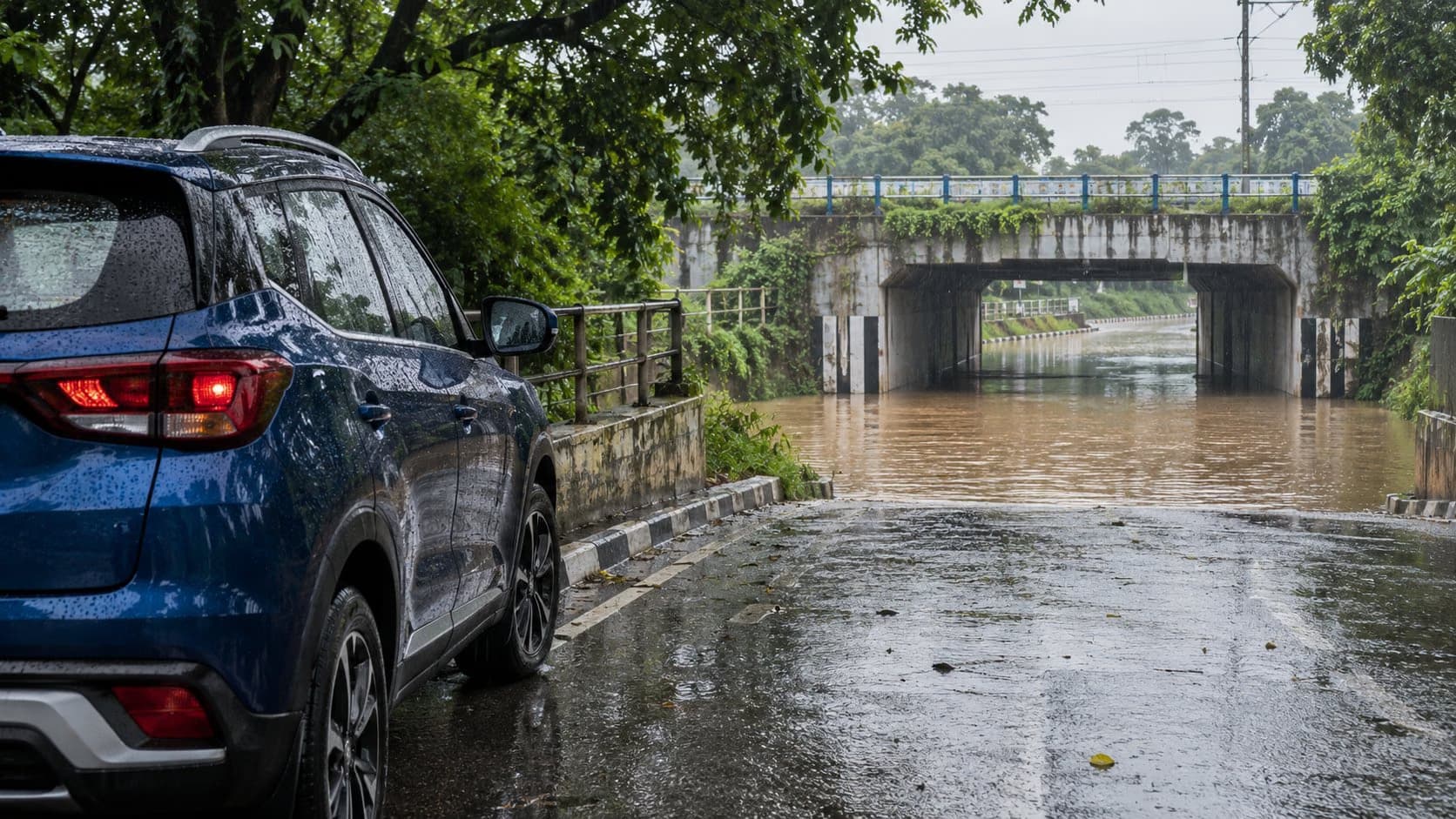
The road to an underpass is dry; the road beyond it has disappeared under brown water. A driver ahead has crossed, and the queue behind you is growing impatient. Neither fact tells you whether the crossing is safe. Floodwater can hide a pothole, an open drain or a damaged roadbed, and its level can rise while you are still in it. The most useful driving decision may be to stop before the water and find another route, even if it adds time.
India’s National Disaster Management Authority safety guidance covers floods and urban flooding; the US National Weather Service is unusually direct about roads: do not drive into a flooded roadway or around a barricade. Honda India’s monsoon advice also identifies submerged underpasses and invisible potholes as hazards. These sources agree on the most important principle: protecting the car is secondary to keeping people out of moving or unknown-depth water.
Why another car crossing proves very little
A taller SUV may have different air-intake and electrical layouts from your hatchback. It may also have been lucky. You cannot see whether its driver encountered a damaged section of road or whether the water has risen since it passed. Even a familiar street can change after heavy rain. The National Weather Service warns that floodwater can conceal washed-out surfaces and debris. That is why estimating depth from the visible tyre of another vehicle is a weak substitute for a clear, dry route.
Do not use advertised ground clearance as a water-wading guarantee. Clearance measures the distance under parts of a vehicle in specified conditions; it does not show the height of its intake, the sealing of every electrical component or the condition of the road beneath the water. Even a vehicle advertised with a wading figure has conditions attached in its manual. In an ordinary passenger car without such instructions, treating the number as a permission slip is a particularly poor bet.
What to do before you reach the water
Slow early, leave space to turn and avoid being boxed in by traffic. If the crossing is flooded, look for a safe place to stop and reroute. Follow police or local authority closures. A barricade is not an invitation to inspect whether the water is “really deep”. If you cannot turn around immediately, wait in a safe position away from the edge and do not let another driver’s horn make the choice for you.
Check official weather alerts and local road updates before a trip when heavy rain is forecast. A navigation app may show a route as open because it has no recent report of flooding; its line on the map is not a measurement of the water. In city underpasses and low stretches, conditions can change faster than a route database updates. Give yourself a second route and enough time to use it.
If the car is already caught
Focus on the occupants. If water is rising or flowing around the vehicle, follow emergency guidance and seek higher ground when it is safe to leave. Do not wait inside a vehicle merely to protect it from damage. Call local emergency services if you need rescue and give a clear location. Avoid walking into fast-moving or electrified water; the safe exit depends on the immediate conditions, and professional responders may be needed.
If the vehicle stalls in water, do not repeatedly crank the engine. Volkswagen India’s safety manual warns that flooded-road driving can stall an engine and damage electrical circuits and says a vehicle that stalls after passing through water should be towed for inspection. It also says not to start a submerged vehicle. Restarting an engine that may have ingested water can turn a recoverable problem into serious internal damage. Move people to safety first, then arrange recovery and inspection.
Do not assume a car with an electric motor is immune. An EV lacks a conventional engine air intake, but its maker still sets limits for water exposure and procedures after flooding. High-voltage components need trained inspection if submerged or damaged. Follow the car’s manual and emergency guidance; do not touch orange high-voltage cables or attempt a roadside electrical diagnosis.
After the water has receded
A car that starts and drives is not necessarily free of damage. Water can remain under carpets or inside electrical connectors. Wet brakes may feel different, and contaminated fluids or an air filter can cause delayed trouble. Ask an authorised or qualified workshop to inspect a car that has been submerged or stalled in water. Tell them how high the water reached and whether the engine was running when it stopped. Photos taken from a safe place can help communicate the event, but do not re-enter dangerous water to take them.
If you have comprehensive insurance, notify the insurer promptly and follow its instructions before authorising repair. Policy wording and optional covers differ; do not assume every water-related engine or electrical repair is automatically paid. Preserve the recovery bill, workshop job card and photographs. The immediate priority is safe recovery, not trying to decide coverage at the roadside.
Why “drive steadily through” is the wrong default advice
Some older tips explain how to maintain momentum through shallow water. They are easy to misapply to an unknown flooded street. The problem is not just engine speed. You cannot judge the roadbed, current, drain openings or hidden traffic. Honda’s monsoon guidance notes how rain worsens visibility and road conditions, while the National Weather Service advises avoiding flooded roads altogether. For an ordinary driver facing an unknown crossing, turning back is a stronger recommendation than memorising a gear and throttle trick.
That can be inconvenient during a commute, but inconvenience is measurable; the depth and condition of a submerged underpass are not. If you need to get home, wait for a safe route or for official clearance. A delayed trip is preferable to placing passengers and rescuers in danger.
A decision you can make in seconds
- Can you see the entire road surface ahead? If not, treat the crossing as unknown.
- Is water moving, rising, or entering an underpass? Stop and turn back.
- Is there a barrier or official closure? Do not cross it.
- Has the vehicle stalled or been submerged? Secure the occupants; do not keep trying to start it.
- After recovery, obtain a professional inspection and document the event for any insurance claim.
The point is not that every puddle requires a tow truck. It is that an actual flooded road is a different hazard from a wet road. Once you cannot assess the surface or the flow, your car’s badge, tyres and ground-clearance figure no longer answer the safety question. The safest route is the one whose road you can still see.
Sources: NDMA SACHET flood guidance; National Weather Service flood safety; Honda India monsoon advice; Volkswagen India safety manual.