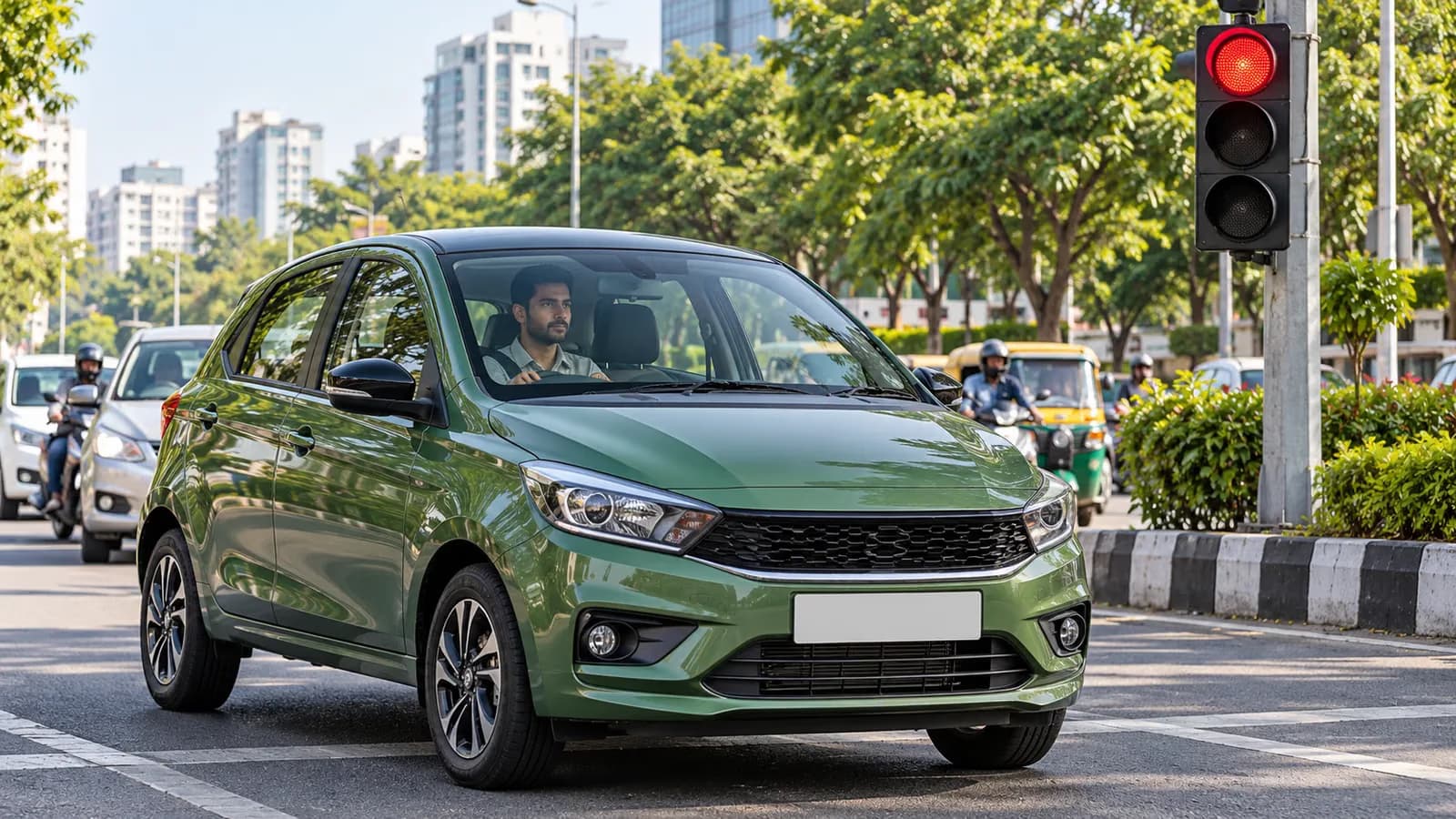
Your car has automatic engine stop-start, yet the engine idles through one traffic signal and shuts off at the next. That inconsistency is often intentional. The system is designed to stop the engine at a standstill only when it can preserve the conditions needed for a reliable restart and acceptable cabin comfort. A brochure's feature tick cannot convey all the conditions its software checks.
For a buyer in a hot Indian city, the useful question is not merely “does it have start-stop?” It is how predictably it operates on your commute, what happens to cooling, and whether the system's behaviour can be understood from the dashboard and manual.
The basic job
When the vehicle is stationary and conditions are suitable, the engine may switch off to avoid burning fuel while idling. It restarts when the driver requests movement or another condition requires the engine. Hyundai's owner guidance describes its Idle Stop and Go system in these terms. That manual explains one implementation; other cars may require different pedal, gear or temperature conditions.
The feature is not the same as switching the entire vehicle off with the ignition button. In an automatic stop state, the car remains ready to restart the engine under system control. For that reason, never leave the vehicle or work near the engine assuming it is fully switched off simply because the engine is silent.
Why it may stay inactive
Battery charge is a major variable. The car's electrical system must have enough energy to run essential loads and restart reliably. A battery-monitoring sensor may estimate its state and prevent a stop when charge is low. Bosch explains how an electronic battery sensor can support start-stop decisions using measured current, voltage and temperature.
Climate control is another. On a very hot afternoon, the car may keep the engine running to support AC performance. A cold engine, extreme ambient temperature, insufficient brake vacuum, an open door or bonnet, a steep incline or a recent restart may also inhibit some systems. Hyundai lists such prerequisites for one of its vehicles. Do not infer the exact thresholds for another car from that list.
Why it can restart while you still wait
The system may restart the engine to maintain battery charge, cabin temperature or another operating requirement even if the brake pedal is held. Hyundai's manual lists examples including low battery charge, an active defroster and insufficient cooling. The restart is not automatically a fault. What matters is whether it follows the car's expected behaviour and whether a warning appears.
Keep control of the brake while waiting, especially on an incline. Do not rely on stop-start to hold the car; that is the job of the brakes and, where present, a separate auto-hold system. The engine stopping is about idling, not parking.
What to test on a drive
- Ask the dealer to show the system's status icon and explain what each colour or message means on the exact variant.
- Try it with the cabin already comfortable and again with stronger AC demand. Note if cooling or restart response changes.
- Observe whether the system works at a normal signal after the engine has warmed, not only in the first minute after startup.
- Ask whether an off switch exists and whether its choice persists after the next ignition cycle.
- Check the owner's manual for the specified replacement battery type and any battery-sensor reset procedure.
Do not test by repeatedly forcing the car to stop in live traffic. A normal supervised drive with a few safe stops is enough to understand the feel. If the restart is harsh or delayed, ask the dealer to inspect it rather than assuming all stop-start systems behave the same.
Battery replacement is not generic
Some stop-start systems require a battery specification and registration or reset procedure compatible with the vehicle. Installing an arbitrary cheaper battery may reduce the system's operation or create electrical issues. Follow the manufacturer's service information. If start-stop becomes consistently unavailable along with slow cranking or other electrical symptoms, have the 12V battery and charging system checked. The stop-start icon alone does not prove the battery is failing.
Will it save a meaningful amount?
The benefit depends on how much of your drive is spent stationary, how long stops last and how often the feature can activate. It is not a fixed percentage for every owner. A driver with long, frequent signals may see more opportunity than one on free-flowing roads. Hot weather can reduce activation because cabin cooling is prioritised. Evaluate the system as part of the car's overall efficiency, comfort and reliability, not as a guaranteed fuel-saving number.
Auto start-stop is most useful when it feels predictable. Know its conditions, respect the vehicle's true off procedure, and investigate persistent warnings. A few inactive stops in traffic are often the system doing exactly what it was designed to do.
Understanding the indicator
Many systems use an icon to show that auto-stop is active, another state to show that conditions are not met, and a warning state when service is required. The colours and symbols differ. Read the manual before diagnosing from an online photograph. A white “not available” indicator on one Hyundai is not necessarily the same as a yellow warning on a different brand. If the system worked regularly before and now never does, note whether any other electrical or climate symptom appeared at the same time.
The bonnet or driver door may be part of the safety logic. A car being inspected with the bonnet open should not be used to judge normal road behaviour. Likewise, a weak battery after prolonged parking can explain temporary non-activation without proving the feature is faulty. If it continues after normal use, ask for a battery and charging-system test.
Maintenance and restart feel
Stop-start puts particular demands on the 12V electrical system and starting strategy. Some vehicles use a battery type designed for repeated cycles, and their management system may need to know when it has been replaced. A routine service that swaps in a visually similar but wrong battery can create confusing symptoms. Keep the battery specification from the owner manual or service information, and ask the workshop to document the replacement procedure.
There is also a comfort dimension. A smooth restart may disappear into the background; a noticeable pause can be frustrating when edging out of a side street. Try the car in the traffic pattern you know, and separate a normal pause from an actual stumble or delayed response. Any repeated stall, warning lamp or failure to restart needs diagnosis, not acceptance as a feature characteristic.
Using the off switch thoughtfully
If the vehicle provides a manual off button, use it according to the manual. Some owners prefer it during a manoeuvre with frequent tiny stops or when cabin cooling is the priority. The system may reactivate on the next ignition cycle. Disabling it for a particular situation does not itself prove it is broken or worthless; the car's software may already inhibit it when conditions are unsuitable.
Do not defeat safety interlocks or modify wiring just to make the system remain off. That can create fault codes and unwanted side effects. A better purchase decision is to test whether the stock system's normal behaviour suits you.