A small light in a side mirror is easy to understand at a glance: another vehicle is near the area you cannot see comfortably. It is also easy to give that light too much authority. Blind-spot monitoring is a warning aid. A dark icon is not proof that the adjacent lane is clear, and a lit one is not permission to stop observing traffic yourself.
For buyers comparing safety equipment, the important details are the system's detection zone, activation conditions and warning style in the exact car being sold. “Blind-spot monitor” on a brochure can cover noticeably different behaviour.
What the system tries to detect
Bosch's blind-spot-detection overview describes sensor-based systems that monitor vehicles near the side and rear, display a warning in the mirror and can add a stronger alert when the turn signal is used. Implementations may use radar or ultrasonic sensors and different software thresholds. That description explains the general technology, not the specification of every vehicle in India.
A system may be intended to help with lane changes at road speed, or include related functions for traffic approaching while reversing. Do not assume both functions are present. Rear cross-traffic alert and blind-spot monitoring are distinct features, even when they share sensors.
Why a warning is not a lane-clearance certificate
Sensors have a designed field of view and operating speed range. Motorcycles, bicycles, very fast approaching vehicles, stationary objects or vehicles in an unusual relative position may be handled differently by different systems. Weather, dirt, bumper damage or sensor misalignment can affect performance. A warning may also illuminate for a vehicle that is close but not on a collision course. The owner's manual states the particular limitations.
Use mirrors, signal appropriately and make a direct shoulder check where it is safe and needed. Then change lanes only when you have judged the space, speed difference and road markings. The system adds information; it does not accept responsibility for the manoeuvre.
A safe test-drive method
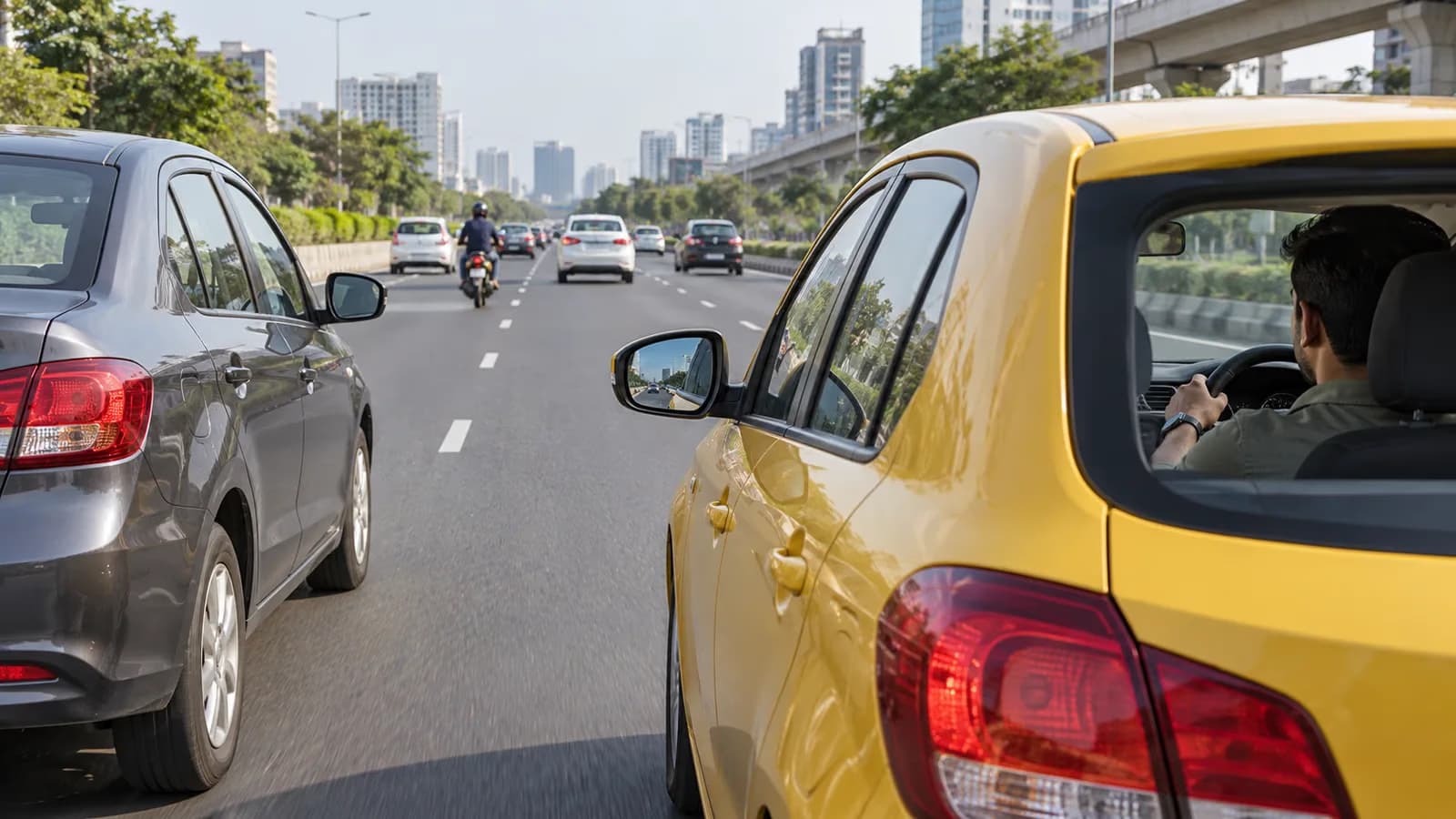
Do not create a near miss just to trigger a light. Ask the dealer to explain the feature while parked, then observe it during normal travel on a multi-lane road with ordinary traffic. Note whether the light appears before or after another car reaches the rear quarter, whether the turn signal adds a sound or vibration, and whether the driver can see the warning in sunlight. A passenger can record observations while the driver keeps eyes on the road.
If the demonstration car is a higher variant, verify the exact trim and mirror assembly in the car you would buy. An icon printed in the mirror housing does not guarantee the feature is enabled, and a missing icon may indicate an entirely different implementation. Read the variant list and test the actual vehicle where possible.
Compare alert designs
Some drivers prefer a discreet amber mirror light; others need a more obvious tone. Too many nuisance alerts can tempt an owner to ignore or disable the feature. Ask whether alert volume or sensitivity can be adjusted, and what happens when the system is unavailable. An explicit unavailable message is more useful than silent failure.
Check how the warning behaves at night. A bright mirror symbol should be visible without distracting from traffic. Test that both sides work and that the display is not obscured by an aftermarket mirror accessory or tint. Simple visibility details matter as much as sensor count.
After a repair
A rear bumper collision, repaint or sensor replacement may call for inspection or calibration. Ask a body shop whether the vehicle maker specifies a procedure. Do not accept a vehicle back solely because no fault lamp is showing; ensure the warning operates normally in a safe, familiar situation. A modification such as a rear carrier may also affect sensor coverage, so check the manual before fitting one.
What to ask the dealer
- Which exact variant has blind-spot warning, and is it standard or optional?
- At what speeds and in which gears is it active?
- Does signalling change the warning, or only the mirror light?
- Is rear cross-traffic alert included separately?
- What message appears if a sensor is blocked or faulty?
- What calibration is required after bumper repair?
Blind-spot monitoring is valuable when it catches a vehicle you might otherwise miss. It is less valuable when it becomes a substitute for looking. Choose a system whose warnings you can notice and understand, then keep the basic lane-change routine intact.
Mirror setup comes first
Before judging the electronic system, set the seat and mirrors correctly. A poorly adjusted mirror can enlarge the blind area and make the feature feel more indispensable than it is. Ask the dealer to help you find a position that gives a useful view of adjacent traffic without losing reference to your own car. Then practise the sequence of mirror check, signal, direct observation and gradual lane change where permitted.
A blind-spot indicator may be most valuable when a vehicle approaches rapidly from behind after you have already checked. It adds a second warning opportunity. It does not tell you that your intended lane has enough space ahead, that another driver will maintain speed, or that a lane change is legal at that point.
City motorcycles and mixed traffic
Indian roads include two-wheelers filtering between lanes, buses with large profiles and cars approaching at very different speeds. A system's ability to detect a small moving object depends on its sensors and software. Do not assume a successful alert for one motorcycle proves that all two-wheelers will be detected. Follow the owner's manual and rely on your own observation whenever the road scene is complex.
Similarly, a light that remains on briefly after a vehicle passes may be a deliberate warning threshold rather than a defect. Observe the pattern over several normal passes instead of constructing an artificial test. If the warning consistently misses ordinary adjacent vehicles or appears when the lane is empty, ask for service.
Related systems are not interchangeable
Lane-keeping assistance acts on the car's position relative to lane markings; blind-spot monitoring observes objects beside or behind. Rear cross-traffic alert typically helps while reversing from a space. Some cars combine these functions in one package, and a few may provide steering intervention or braking in defined circumstances. Never infer intervention from a mirror light alone. Ask the salesperson to identify each function separately in the variant sheet.
At delivery, confirm any settings you chose during the test drive. Software updates or battery disconnection can change preferences. Know how to recognise an unavailable state, because a driver who assumes the system is working when it is off has lost the benefit it was meant to add.
A realistic value judgement
The feature may be especially worthwhile in a vehicle with a thick rear pillar or restricted rearward view, but outward visibility itself still deserves attention. Compare cars from the driver's seat, not just from a list of safety acronyms. If a lower variant lacks monitoring but has good mirrors and visibility, it may be easier to live with than a higher variant with poor basic sight lines. Safety technology works best when it reinforces sound driving practice.
Make one final check on a cloudy day or in evening light if a later test drive is available. A mirror icon that disappears in glare or competes with reflections may be less useful in daily driving than its brochure description suggests. The warning has to reach the driver at the right moment, not merely exist as hardware.