At a long signal, Auto Hold can feel almost magical: the car remains still after you lift your foot off the brake. That ease is precisely why the feature is easy to misunderstand. It holds a stopped vehicle under its operating conditions. It is not a licence to leave the driver's seat, and it is not the same decision as securing a parked car.
Hyundai's Auto Hold owner instructions say the function maintains brake pressure after the driver brings the vehicle to a complete stop, and that it releases when the accelerator is pressed in a drive gear. A Volkswagen Tiguan manual likewise describes Auto Hold keeping a vehicle stationary after the brake pedal is released. Both illustrate the concept; the exact controls and conditions on the car you buy are in its own manual.
What the two controls do
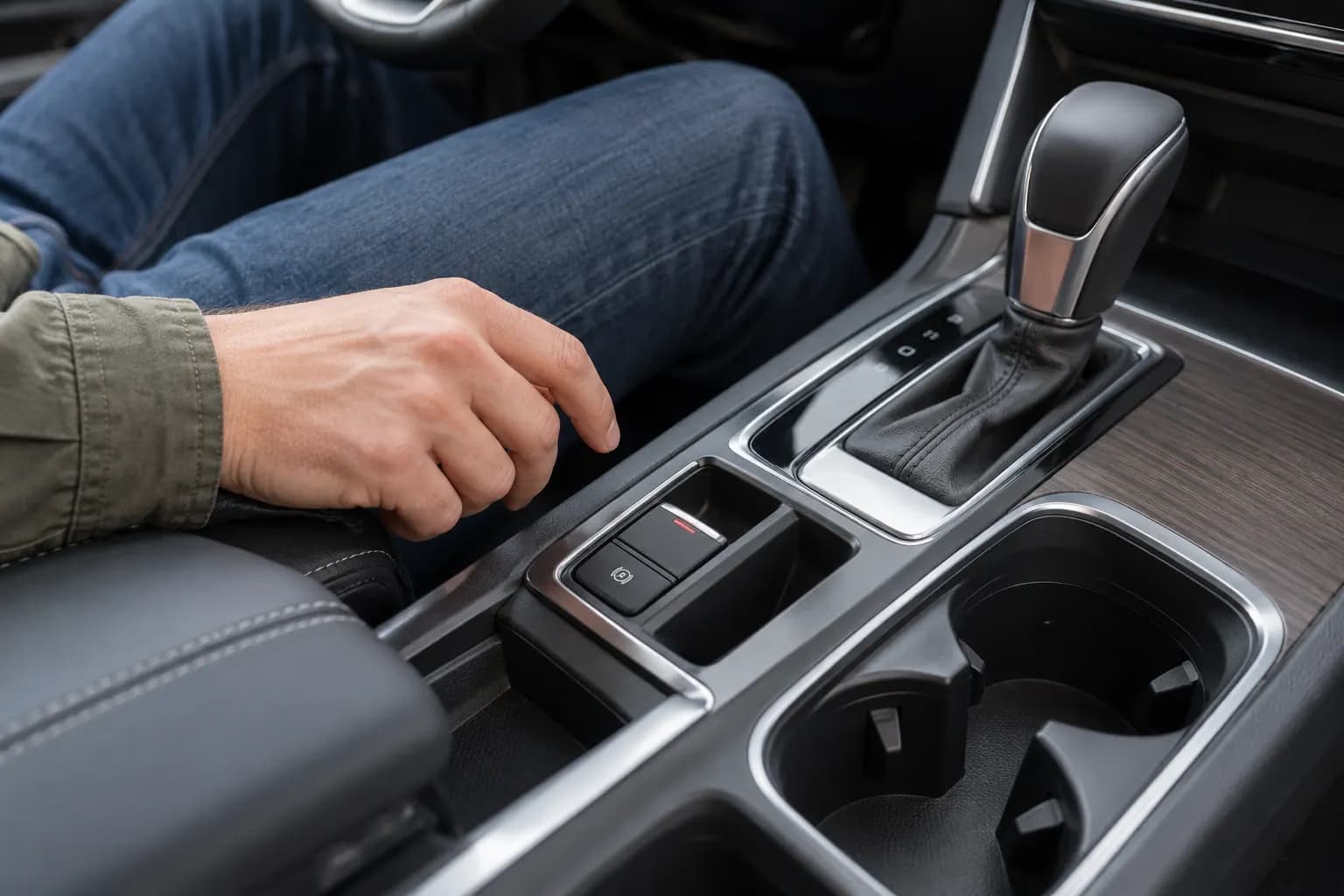
Auto Hold is a driving convenience for repeated stops. The electronic parking brake, often called EPB, is a parking system operated by a switch instead of a mechanical hand lever. Cars can transfer from Auto Hold to EPB automatically under certain conditions, but that behaviour is model-specific. Hyundai's instructions list circumstances in which the parking brake applies automatically, including a prolonged standstill or opening the driver's door on the vehicle described. Do not assume every car follows the same sequence.
The indicator is part of the story. In Hyundai's example, a white Auto Hold lamp shows readiness and green shows active holding; a yellow indication can signal a fault. The parking-brake warning lamp is separate. Learn what your car's display actually means. A lit button by itself may show the feature is selected, not that it is currently holding the vehicle.
A safe way to try it before purchase
During a supervised test drive on level ground, stop fully with the foot brake, engage Auto Hold according to the manual and verify the active indicator before lifting your foot. Keep your foot ready to brake. Then, with clear space ahead and the instructor's agreement, note how smoothly the car moves away. Some systems react differently depending on seat belt, door, gear position or slope. Do not experiment on a steep ramp or in traffic simply to prove a feature works.
Repeat a conventional parking routine before ending the test. Stop, keep the foot brake pressed, select Park or the manual-transmission position required by the manufacturer, apply the parking brake if the manual directs, and confirm the warning indicator. Auto Hold being on earlier is not evidence that the car is safely parked now.
When the system stops holding
Features designed for convenience can have conditions under which they will not engage or will hand over to another system. Hyundai's manual says Auto Hold does not operate in certain gear positions or when the EPB is applied, and it describes warnings when a handover fails. If your car displays a prompt to press the brake, do that first and then read the message. Do not treat an unfamiliar warning as a nuisance to clear by pressing the accelerator.
Auto Hold may also make close manoeuvres feel different. When inching into a parking bay, a driver may prefer finer control with the foot brake. Learn how to switch the feature off according to the manual, with the brake pedal depressed where instructed. The point is predictable control, not declaring Auto Hold universally good or bad.
Auto Hold is also distinct from hill-start assistance. Hill-start assist is typically intended to reduce rollback briefly when a driver moves off on a slope. Auto Hold is a selectable standstill function on equipped cars and may remain active through a traffic stop until the driver accelerates or a condition changes. Even if a brochure lists both, ask for a demonstration of each. A short incline in a dealership driveway is no place to learn by guessing which system is holding the car.
For a manual car, check the maker's clutch and gear instructions carefully. Volkswagen's manual explains a manual-transmission situation differently from an automatic one. In particular, do not rely on a generic online video to decide whether to hold the clutch down for a long wait. Vehicle-specific operation, traffic conditions and the manual matter more than a one-size-fits-all habit.
Do not use the EPB switch as a routine moving brake
Some electronic parking brake systems include an emergency-braking function if the normal pedal cannot be used. That does not make the switch a substitute for ordinary braking. Hyundai's EPB instructions reserve operation while moving for an emergency and warn that stopping distance can be longer. The way it works varies by vehicle; read the specific manual rather than trying it out.
For a buyer, the useful questions are simple: can you identify the active-hold indicator, can you cancel the function confidently, and do you know how to verify the parking brake is set? If the salesperson cannot explain those on the exact variant, ask for the relevant manual page before delivery.