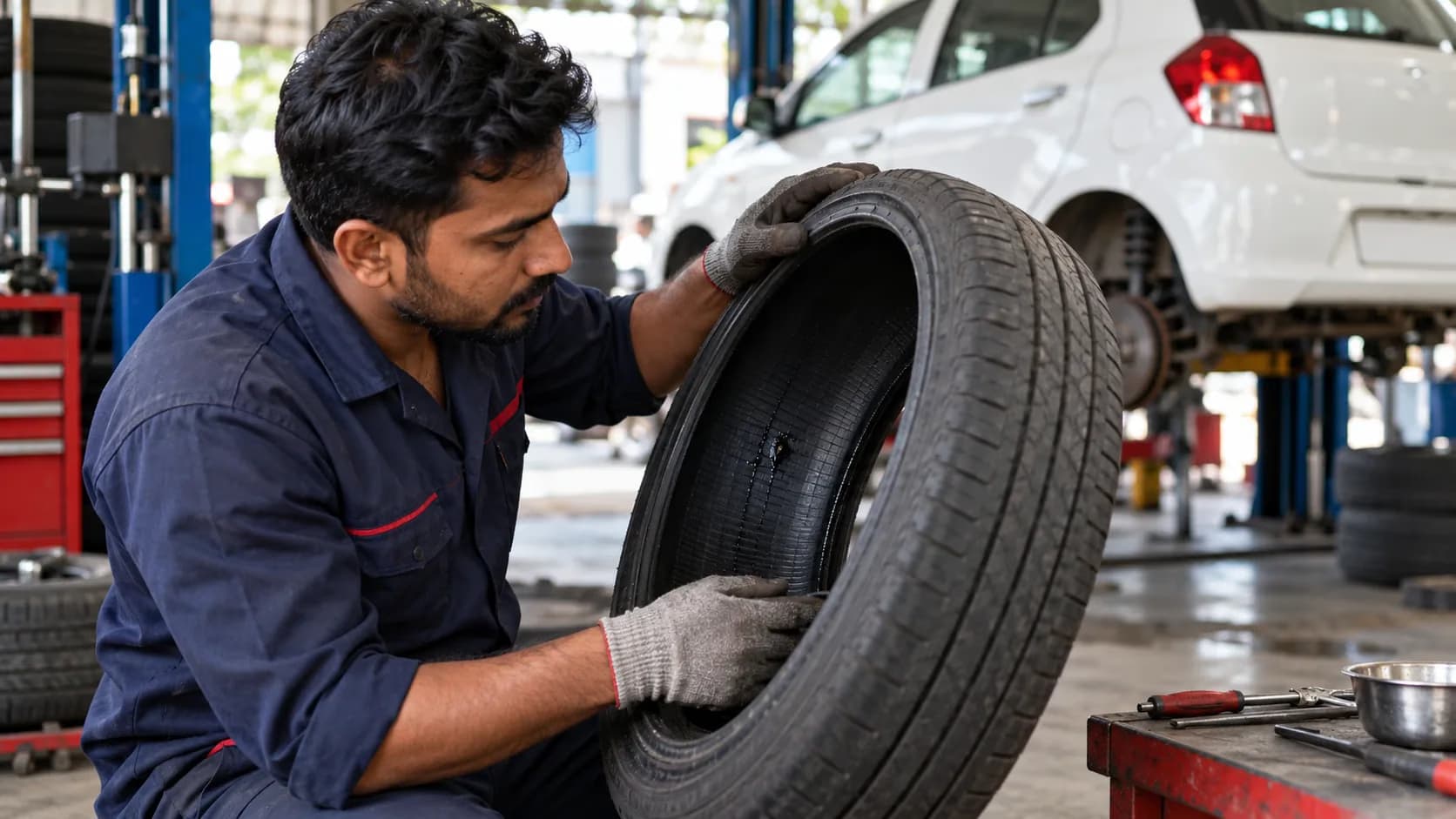
At a tyre shop, “alignment and balancing” is often offered as one package. They are separate operations. One changes the angles at which the wheels sit and point; the other corrects uneven mass around a rotating tyre-and-wheel assembly. Buying both without identifying the symptom can leave a vibration untouched, or conceal a suspension problem that needs repair first.
Alignment is about wheel geometry
Wheel alignment checks and, where the vehicle allows, adjusts angles such as toe, camber and caster against the manufacturer's specification. A car that persistently pulls to one side on a reasonably level road, a steering wheel that is off-centre when travelling straight, or a pattern of uneven tyre wear can justify inspection. Michelin India distinguishes alignment and balancing and explains that alignment errors can contribute to directional pull and abnormal wear.
A road camber, crosswind or mismatched tyre pressure can also create a sense of pull. Check pressures cold using the vehicle's specified values, and do not diagnose alignment from one sloped street. A hard pothole strike, curb impact or replacement of steering or suspension components is a more concrete reason to ask for an alignment check. The technician should inspect for worn or bent parts before attempting to adjust around them.
Balancing is about rotation
Even a sound tyre-and-wheel assembly can have small mass differences around its circumference. A balancing machine measures the imbalance and guides placement of correction weights. Vibration that appears in a particular speed range, especially after tyres were changed or repaired, often prompts a balance check. It is not proof: wheel damage, tyre defects, suspension wear and other faults can also cause vibration.
Note where you feel the shake: the steering wheel, seat or whole car. Record the speed band and whether it changes with braking or acceleration. A vibration mainly while braking should not be treated as a routine balancing job; braking components may need inspection. A bulge or obvious tyre damage requires professional attention before any high-speed test.
The common mix-ups
Balancing a wheel does not change the direction in which it points. Alignment does not redistribute mass around a tyre. A car can need both after new tyres, but it can also need only one or neither. If a workshop reports that a wheel needs repeated large weights, ask it to inspect the wheel and tyre rather than simply adding more correction. If an alignment printout shows values still outside specification, ask why.
Uneven wear has many patterns. One-sided shoulder wear may suggest geometry, but sustained wrong pressure, driving style or mechanical wear can also contribute. A technician should inspect all tyres and compare before-and-after measurements. Tyres already worn into an irregular shape may continue to make noise even after the geometry is corrected.
Questions to put on the job card
- What symptom are we trying to fix, and what did the road test show?
- Were tyre pressures and visible damage checked before measurement?
- Can I see the before-and-after alignment readings against the model's specification?
- Which wheels were balanced, and was any rim or tyre damage found?
- If the car still pulls or vibrates afterwards, what is the next diagnostic step?
Keep the printout or digital report with your service record. It gives a future workshop a reference if the same complaint returns, and it helps distinguish a genuine adjustment from a generic charge on the invoice.
After a tyre change or pothole
New tyres should be mounted and balanced correctly. Alignment is worth checking when wear patterns, steering behaviour, impact history or the vehicle manufacturer's service guidance justify it. A severe pothole can damage a tyre, rim or suspension as well as disturb wheel angles. Inspect first; do not continue to drive at highway speed with a vibration or damaged sidewall simply because an appointment is booked for next week.
After service, use the same route and speed band where the original issue appeared, within safe and legal limits. A properly completed job should address the reported symptom. If it does not, return with the notes and ask for further diagnosis rather than paying for the same operation again.
Why the distinction saves money
The aim is not to avoid preventive maintenance. It is to buy the service that matches the evidence. An alignment report can protect a fresh set of tyres from rapid uneven wear; careful balancing can make a long drive smoother. Neither should be sold as a cure for every rattle, pull or brake judder. Tell the shop what you feel, ask what it measured, and decide from that result.
Reading a tyre as evidence
Ask the workshop to show you the wear across each tyre, not merely to state that “alignment is out”. Wear on the inner shoulder, outer shoulder or both edges can offer clues, but none identifies one cause on its own. Inflation history, rotation pattern, mechanical play and driving conditions matter. If the tyre has a bulge, exposed cord or a cut, the immediate question is whether it is safe to use, not whether alignment can rescue it.
Tyre rotation can even out some differences when the manufacturer permits it, but it cannot reverse damage or repair a bent component. Record the position of each tyre before rotation if you are tracing a persistent pull. When symptoms change after tyres are swapped side-to-side, that information may help diagnose the tyre itself.
What a good alignment report contains
A useful report identifies the vehicle setting selected by the machine and shows measurements before and after any adjustments. Values should be compared with the correct variant specification. Ask which angles were actually adjustable and whether a non-adjustable out-of-range measurement points towards wear or damage. A green screen alone does not tell you why the car felt wrong. A good technician can explain the result in ordinary language and connect it to the road-test symptom.
Before paying, confirm that the steering wheel is centred on a level road and that no warning remains after any required steering-angle calibration. If the wheel remains crooked, return immediately and show the report. Repeated adjustment without investigating a bent part or tyre problem wastes time and can consume fresh tread.
What balancing cannot fix
Balancing weights correct an uneven distribution of mass. They cannot make a bent rim round, repair a tyre with internal damage or fix worn suspension joints. Some vibrations arise only under engine load and may have drivetrain causes. If a shop balances all four wheels but the vibration persists at the same speed, insist on the next diagnostic step rather than another identical balance.
Also distinguish normal road texture from an abnormal rhythmic shake. A test on a smooth, legal-speed road is more useful than trying to feel the problem on a rough lane. Tell the technician if vibration began immediately after a tyre repair, wheel swap or pothole hit. The timeline narrows the investigation.
Planning maintenance without a ritual
Use your owner's manual and tyre manufacturer's guidance for routine checks. Inspect pressures and tyre condition regularly, and ask for alignment after a significant impact, irregular wear or a component repair. Balance tyres when fitting them and investigate speed-related vibration promptly. A fixed package at every service is not automatically harmful, but it should not replace observation. The goal is predictable steering, safe tyres and evidence that the complaint has actually been solved.