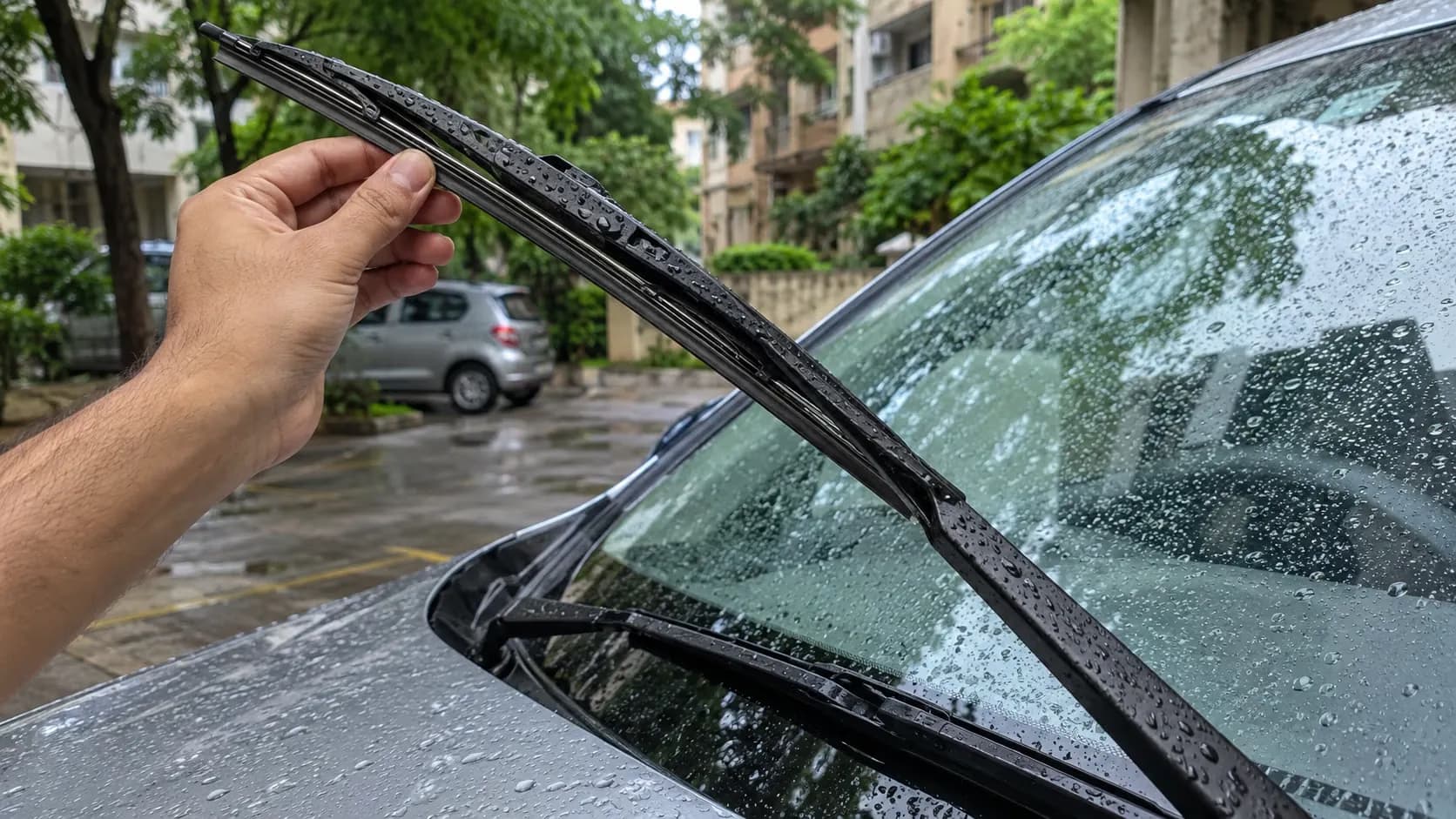
The first rain after weeks of dust can turn a perfectly familiar commute into a blur. You pull the stalk, the blades sweep, and a grey arc stays directly in your line of sight. Buying the first replacement pair at a fuel station may fix it. It may also leave the real cause, a dirty screen or poor washer spray, exactly where it was.
Park before investigating. Repeatedly trying to clear a badly smeared screen in moving traffic is not a diagnostic method. Bosch's light-and-sight guidance notes that dirt, insects and film on the glass can resist plain water, while worn or incorrectly fitted blades can streak too. Those are separate problems and deserve separate checks.
Start with the glass, not the rubber
Wash the windscreen with a cleaner suitable for automotive glass and a clean cloth. Pay attention to the area where the blade changes direction, where oily road film tends to remain. Clean the outside thoroughly, then check the inside as well: an interior film can make a good wipe look worse than it is, particularly against low sun or oncoming headlights. Avoid abrasive tools and products that might damage coatings; follow the car and glass-care instructions.
After cleaning, wet the glass using the washer and make a brief test sweep. Toyota's owner instructions for wipers and washers explicitly caution against running blades on a dry windscreen because it can damage the glass. That advice also explains why testing an old blade dry in the showroom car park is a poor idea.
What the pattern can tell you
A narrow line that appears at the same place on each sweep can point to a damaged or contaminated section of blade edge. Broad smearing across the whole wiped area can come from a dirty screen, a degraded edge or unsuitable washer mixture. Chatter or judder may have several causes, including contamination and fitting. These are clues, not a remote diagnosis: if cleaning does not change the pattern, inspect the blade carefully with the wipers parked and the vehicle switched off.
Look for torn rubber, an uneven edge, a blade that has come away from its frame, or a loose connector. Never pull hard on the arm if it is hidden under the bonnet line. Some vehicles require a service position before the arm can be lifted; Toyota's replacement guide advises checking the manual for the correct blade and connector and warns against lifting retracted blades beneath the bonnet. A spring-loaded arm can also strike and crack the glass if released carelessly.
Check the washer system
Does fluid reach the area the blades will sweep, or merely dribble at the base of the screen? Check the reservoir level and the vehicle's specified fluid. Toyota's washer-fluid guide explains how to top up the reservoir. Its owner manual also advises checking for fluid and blocked nozzles when there is no spray, while cautioning against holding the switch on an empty tank. Do not jab a nozzle with a pin: delicate outlets can be damaged or knocked out of alignment.
If one side sprays weakly, there may be a blocked nozzle, a kink or a pump problem. If both sides fail and the reservoir is full, do not assume the blades are the culprit. Have the system inspected. A new blade cannot clear a screen that never gets wet.
Rain-sensing wipers add another wrinkle. A sensor can choose when to sweep, but it cannot make a worn edge clean properly. If the blades start unexpectedly while you are washing the glass, they can catch your hand. Toyota's owner guidance says to take care around an automatic wiper system and switch it off in an automatic car wash. Before replacing blades, learn the vehicle's service position and disable automatic operation as its manual directs.
There is no magic month at which every blade becomes unsafe. A car parked outdoors in strong sun, one used through dusty roadworks and one kept in a covered garage lead different lives. Judge the wiped view and rubber condition, not only the date on a service reminder. If one blade is damaged, check the other too; buying a matched pair may be practical, but fit and condition matter more than a blanket rule.
Replace by fit, not by appearance
Blades can differ in length, curvature and attachment. Some cars use different lengths on the driver and passenger sides; rear blades can be a third fitment. Record the model year and the exact vehicle, then check the owner's manual or a fitment catalogue. A blade that clips on but is too long can foul the other blade or the screen edge. A blade that is too short leaves a wider unwiped sector.
When fitting, protect the glass with a folded cloth beneath the arm and keep hold of the arm at all times. Make sure the connector audibly or visibly locks according to its instructions, lower it gently and test with washer fluid. If a fresh correctly fitted blade still leaves the same streak after glass cleaning, investigate screen condition and arm alignment with a competent workshop rather than replacing the blade again.
Ask the fitter to demonstrate that the blade clears the swept arc without touching the screen surround. Watch it on both the upward and return strokes. A poor fit may only become apparent at the top of the sweep, and that is not a problem you want to discover during the first highway shower. Keep the packaging until the wet test is complete so that the exact part number can be checked if something is wrong.
Before the next downpour
Do this check in daylight, not only when visibility has already deteriorated. Confirm that the front washers cover the swept area, the rear wiper works if fitted, and the blades clear without skipping. Keep the washer topped up with a compatible fluid. If visibility becomes poor in a storm, slow down and stop somewhere safe; a working wiper is only one part of driving within what you can see.