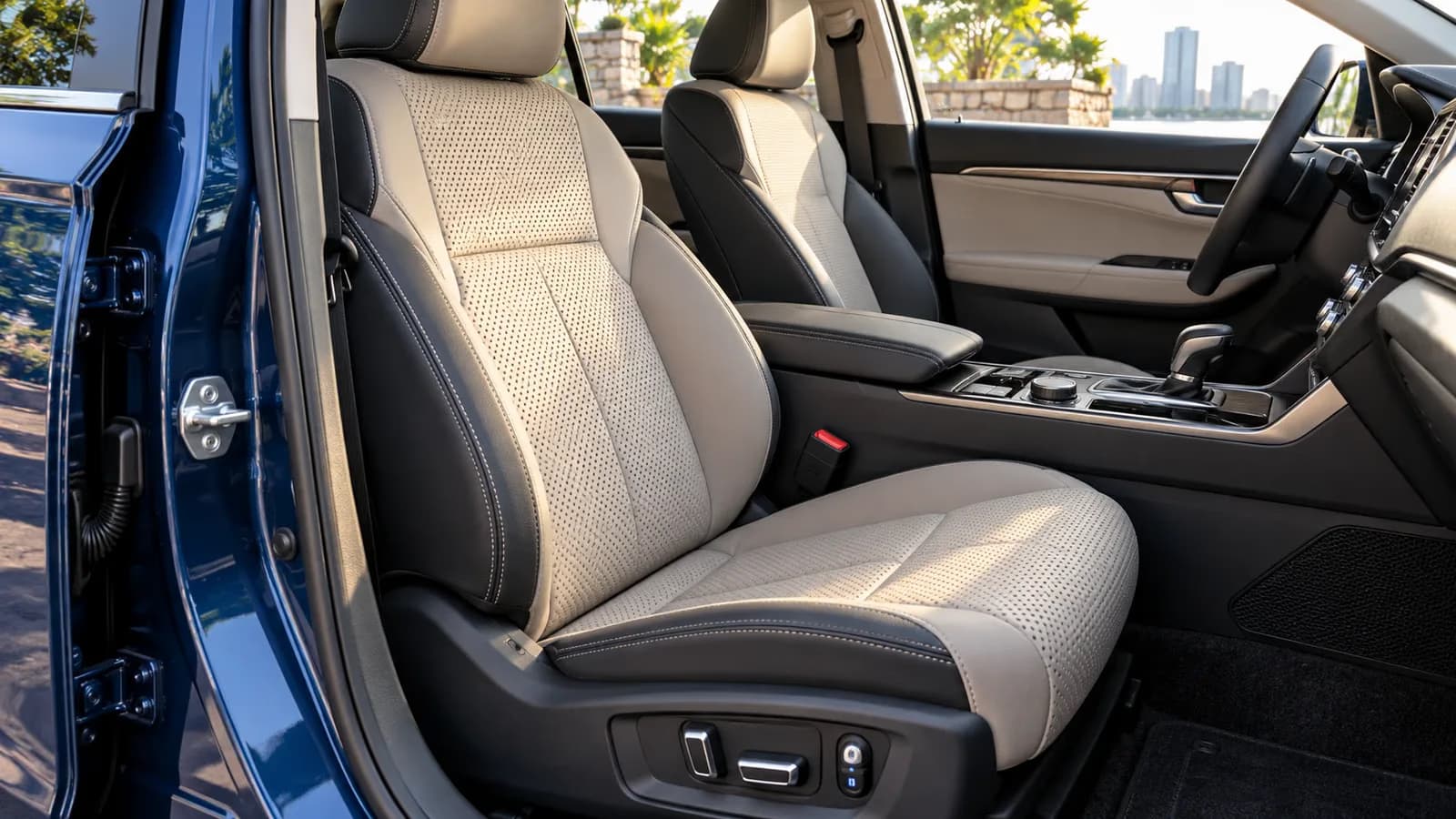
Ventilated seats sound like a natural answer to a car that spends hours parked in Indian summer heat. But the label is easy to over-read. Some systems move cabin air through small holes in the cushion and backrest; they are not little refrigerators inside the seat. If the cabin itself is hot, the first sensation may be airflow rather than an instant cold surface. That difference matters when a feature costs a higher-trim premium.
What the feature usually does
Hyundai's seat-ventilation owner guidance describes air being blown through small holes in the cushion and seatback. It also advises using the system with climate control and avoiding blocked intake paths or aftermarket covers that interfere with the ventilation. This is a specific manufacturer's example; the design, air source, fan speeds and seat coverage vary between models.
Ventilation can help reduce the sticky feeling between clothing and upholstery. That is different from lowering the temperature of the entire cabin. In a truly hot car, effective AC, shaded parking and sensible pre-cooling often have a larger initial effect on comfort. Consider the seat as an addition to cabin climate control, not its replacement.
Test the actual seat, not a feature list
Ask the showroom to activate the feature in the exact variant you are considering. Sit in your normal driving position, with the backrest angle and seat height adjusted properly. Try each fan level for several minutes. Feel whether airflow reaches both back and cushion, and whether it remains noticeable through your usual clothing. A short one-second button press is not a meaningful test.
Listen for fan noise with the car stationary and again during a drive. Some people welcome the airflow but find a high setting audible in a quiet cabin. Others feel very little through thick clothing. Neither reaction can be settled by a brochure. Check whether the driver and passenger seats have the same function; a trim description may not imply both.
The parked-in-sun scenario
Heat-soaked upholstery can be uncomfortable before any fan has time to help. On a safe test, compare the seat after the cabin AC has run for several minutes. If possible, revisit a display or demonstrator car after it has stood outdoors, because an air-conditioned showroom disguises how the feature behaves in real use. Do not demand a dangerous test in extreme conditions; the aim is to understand the sequence of cooling, not to prove endurance.
Notice whether the ventilation turns off with the ignition, remembers a setting, or can be controlled through a physical button while driving. A buried touchscreen menu makes a small convenience feature surprisingly awkward on a daily commute.
Upholstery and ownership details
Perforated material can be pleasant but needs care. Food crumbs, liquid spills and harsh cleaning chemicals can obstruct holes or damage the seat. Hyundai's guidance specifically warns against covering vents, using unsuitable solvents and adding seat covers that interfere with operation. Follow the manual for the car you buy. A decorative aftermarket cover can make a paid feature ineffective, and a thick cushion may change driving position and belt fit.
Ask how the seat is cleaned and whether the ventilation fan can be serviced if it fails. If the car is used by children, consider spill habits and ease of cleaning alongside comfort. Do not assume perforation means every part of the seat is ventilated; check the actual airflow zones.
Compare features as a package
A more expensive variant may bundle seat ventilation with wheels, sunroof, cameras or audio equipment you do not value. Compare the total price gap with the number of hot-weather trips and the performance of the base car's AC. A well-ventilated seat is nice, but it should not outweigh poorer seat support or a driving position that causes fatigue. Spend at least part of the test drive judging the seat with the ventilation off, because you will use its shape on every trip.
Questions for the dealer
- Which seats are ventilated in this exact variant?
- Does the system circulate cabin air or use a separate cooling arrangement?
- Are cushion and backrest both ventilated, and how many fan settings are available?
- Can the feature be controlled without leaving the driving view on the screen?
- What cleaning or seat-cover restrictions does the manual specify?
- Can I test it with the AC running after the car has been parked outside?
Ventilated seats are best judged as a tactile feature. Try them, listen to them and consider maintenance. If they improve your own summer commute enough to justify the trim difference, they are useful. If all you feel is a fan sound while the seat itself does not suit you, the feature label should not make the decision.
A comparison worth making
Try the same car with and without seat ventilation while maintaining the same cabin AC setting. That isolates the seat's contribution better than comparing two different cars on different days. Give it time. You may notice that clothing feels less damp even though the seat does not become cold to the touch. That can still be useful, particularly on longer drives. If the fan only feels effective on its loudest setting, decide whether the trade-off is acceptable.
Compare a lighter-coloured cabin and a darker one if the model offers both. Material and sun exposure may matter more to the first-minute experience than the fan itself. Do not infer upholstery durability merely from its appearance; inspect stitching, perforation and the service guidance.
What an aftermarket cover changes
A universal seat cover can block perforations or the fan intake. It may also interfere with side-airbag deployment if it is not specifically approved for the seat. Ask the manufacturer or dealer before fitting one. If you already rely on a cushion for comfort, test the original seat shape first; adding a cushion later may negate the ventilation benefit and alter posture. Family buyers should weigh cleanability against airflow rather than treating the feature as an isolated gadget.
When the function seems weak
Confirm that the switch is on, the chosen level is not low and the cabin climate control is operating as recommended. Check whether something under the seat blocks its intake, without touching wiring or connectors. If one seat performs differently from the other in identical conditions, record the discrepancy and ask for inspection while warranty is active. Avoid pouring liquid into perforations or using household solvents to “clean the ducts”.
A used car with ventilated seats deserves a test of every fan setting. A working button light does not prove adequate airflow. Note unusual rattles and check whether the seat cushion has been replaced or covered. The feature has value only when it works, is comfortable and can be maintained.
The value question
Think about where the car is parked, how long your drives last and who occupies the front passenger seat. A driver making brief shaded trips may hardly use ventilation, while someone commuting in afternoon heat may appreciate it daily. The purchase decision should be based on this frequency and the actual sensation in the car, not an assumption that every perforated seat is chilled.
For shared family use, let both regular drivers sit in the car before deciding. Seat height, lumbar support and ventilation may feel quite different to people of different sizes. A feature that impresses one person during a short showroom visit may be irrelevant to the person who drives most days. Comfort is personal; the test should be too.