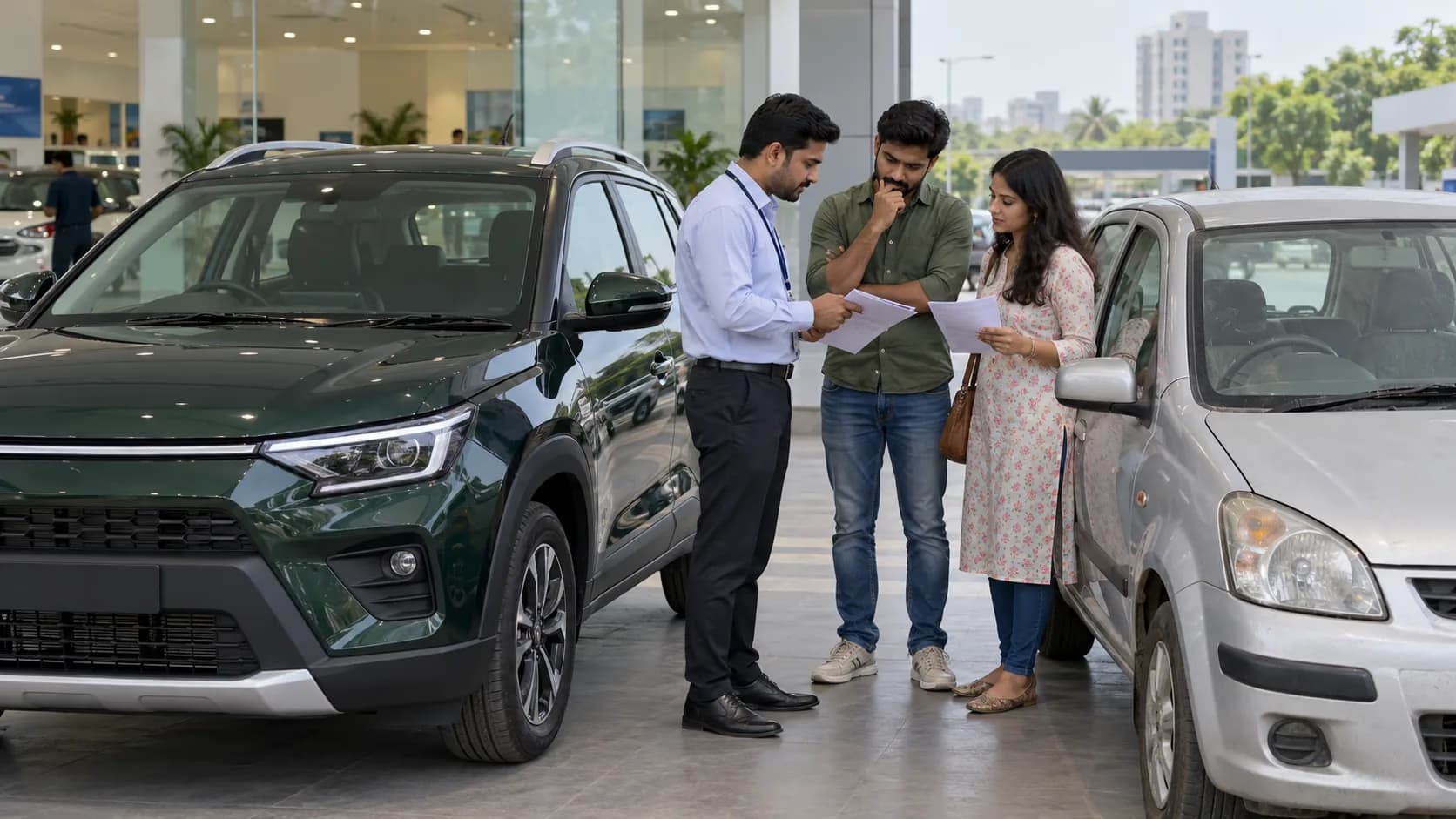
Two car dealers can show you the same monthly EMI and offer very different loans. One may have a longer repayment period, a higher processing charge or costly terms if you repay early. The payment that fits this month's budget is only one part of the decision. Before agreeing to finance at the showroom, ask for the lender's written terms and compare the whole amount you will pay.
Put every quote on the same footing
Write down the on-road price, your down payment, the exact amount financed, the interest rate, the loan type, the tenure in months, the EMI and any up-front charges. Add the total of all scheduled instalments and the cash paid at the start. Only then compare offers. A dealer may bundle insurance, accessories or an extended warranty into the financed amount; if you did not intend to buy those items, the seemingly convenient loan also makes them costlier over time.
Autocar India's car-loan calculator guidance notes the trade-off: a longer tenure tends to lower the EMI while increasing total interest. The US Consumer Financial Protection Bureau similarly recommends comparing amount financed, rate, term and monthly payment rather than the instalment alone. These are general comparison principles; your Indian lender's contract is the governing document.
Ask for the Key Facts Statement
For a loan from an RBI-regulated lender, ask for the applicable Key Facts Statement, or KFS, before you sign. RBI's KFS circular for retail and MSME term loans requires regulated lenders to provide a standardised statement before the contract, with an APR computation and amortisation schedule. The annual percentage rate, or APR, is intended to reflect the annual cost of credit including applicable charges, not just the advertised interest rate.
Check that the KFS identifies the lender, amount, tenure, rate type, repayment schedule and applicable fees. If anything in the verbal sales pitch differs from the written statement, stop and resolve it before paying a booking or processing fee. An approval message is not the same as a final sanction document, and the rate offered to a particular borrower can differ from an advertisement.
EMI can hide the effect of tenure
Suppose two quotes finance the same amount at the same rate, but one stretches repayment further. The longer plan can look easier month to month, yet you are paying interest for more months. Do the calculation with the exact sanctioned amount and rate, not a rounded sales illustration. Ask for total scheduled interest and total repayment on each quote. A loan calculator is useful for screening offers, but a final repayment schedule is better for confirming the numbers.
A longer tenure may be reasonable if it protects essential household cash flow. The point is to choose it deliberately, not because a salesperson presented only the smaller EMI. Budget for insurance renewals, fuel or charging, maintenance and parking in addition to the instalment. A car that only just fits the EMI can still be unaffordable to run.
Look beyond the headline rate
Processing, documentation and other charges may be payable before disbursal or financed into the loan. Ask whether each fee is refundable if the loan is not sanctioned, and whether taxes apply. Check late-payment charges, part-prepayment and foreclosure conditions. Lenders' published schedules can differ: for example, ICICI Bank lists car-loan service charges, while HDFC Bank publishes its own rate and charge schedule. Those pages illustrate why you must read the current terms of the lender actually financing your car, not copy a fee from another bank.
Do not assume that an early payoff is free or expensive. It depends on the loan product, rate type, borrower category, contract and applicable rules. Ask the lender to show the exact condition in writing. If you expect a bonus or asset sale that might let you repay early, this clause can matter as much as a small difference in the quoted interest rate.
Fixed, floating and the reset question
Check whether the rate is fixed for the full term or can change, and what benchmark or reset rule applies if it floats. Do not rely on the word "fixed" alone; read the sanction letter. For a floating-rate loan, ask what happens to EMI or tenure when the rate changes, how you will be informed, and whether you have choices about repayment. RBI has published borrower guidance on rate resets for applicable EMI-based personal loans. Confirm that the rule applies to your product rather than assuming all car loans work identically.
Separate the car deal from the financing deal
Negotiate and record the vehicle's on-road price independently of the loan. A discount tied to dealer finance may be real, but compare its value with the extra finance cost or bundled products. Ask for two written breakdowns: one for the car and optional items, another for the loan. This makes it harder for a change in one column to disappear into the other. It also lets you compare a bank quote obtained directly with the dealer-arranged offer.
Check the final paperwork for the same lender, principal, term and EMI you approved. Do not sign blank forms or rely on screenshots sent by an intermediary. If a fee is described as mandatory, ask which document requires it and who receives it. Keep copies of the KFS, sanction letter, repayment schedule and receipts. An email or digital copy is far more useful later than a remembered verbal promise.
Watch the amount financed at delivery
The loan amount can change between an initial quotation and delivery if the car price, insurance premium or selected accessories change. Before disbursal, compare the final invoice with the amount in the sanction letter. If you arranged a larger down payment, check that it actually reduced the principal rather than being offset by a new add-on. A small increase in financed extras is easy to miss when the EMI rises only slightly, but you still repay the whole amount with interest.
Ask how the lender handles a cancellation or a delayed vehicle allocation, particularly if a processing fee or booking amount has already been paid. Do not infer refund rights from a salesperson's reassurance; check the written booking and loan terms. If the car's delivery date moves, confirm when interest begins and whether the repayment schedule changes. The exact answer depends on disbursal timing and the signed contract.
Use a realistic household budget
A monthly payment has to coexist with routine spending and an emergency reserve. Calculate what remains after rent, existing debt and essential household costs, then add the car's running expenses. Leave room for an insurance renewal, tyres or an unexpected repair rather than treating the first month's budget as a permanent forecast. An attractive rate is not helpful if the repayment leaves no margin for life outside the car.
It is sensible to seek more than one lender's written offer in a short, deliberate comparison window. Eligibility and rates depend on the applicant and product, so public rate tables are starting points, not promises. Compare the final documents for the same loan amount and term. If a dealer says a discount disappears unless you sign immediately, ask for the offer in writing and take time to read it.
The comparison that matters
For each offer, put the down payment, all up-front fees, total scheduled EMIs and optional products in one column. Then consider the rate type, prepayment freedom and what happens if an instalment is missed. The cheapest EMI is not necessarily the least expensive loan, and the lowest advertised rate is not necessarily the least expensive agreement. A written, like-for-like comparison is the simplest way to keep the excitement of a new car from obscuring the cost of borrowing.