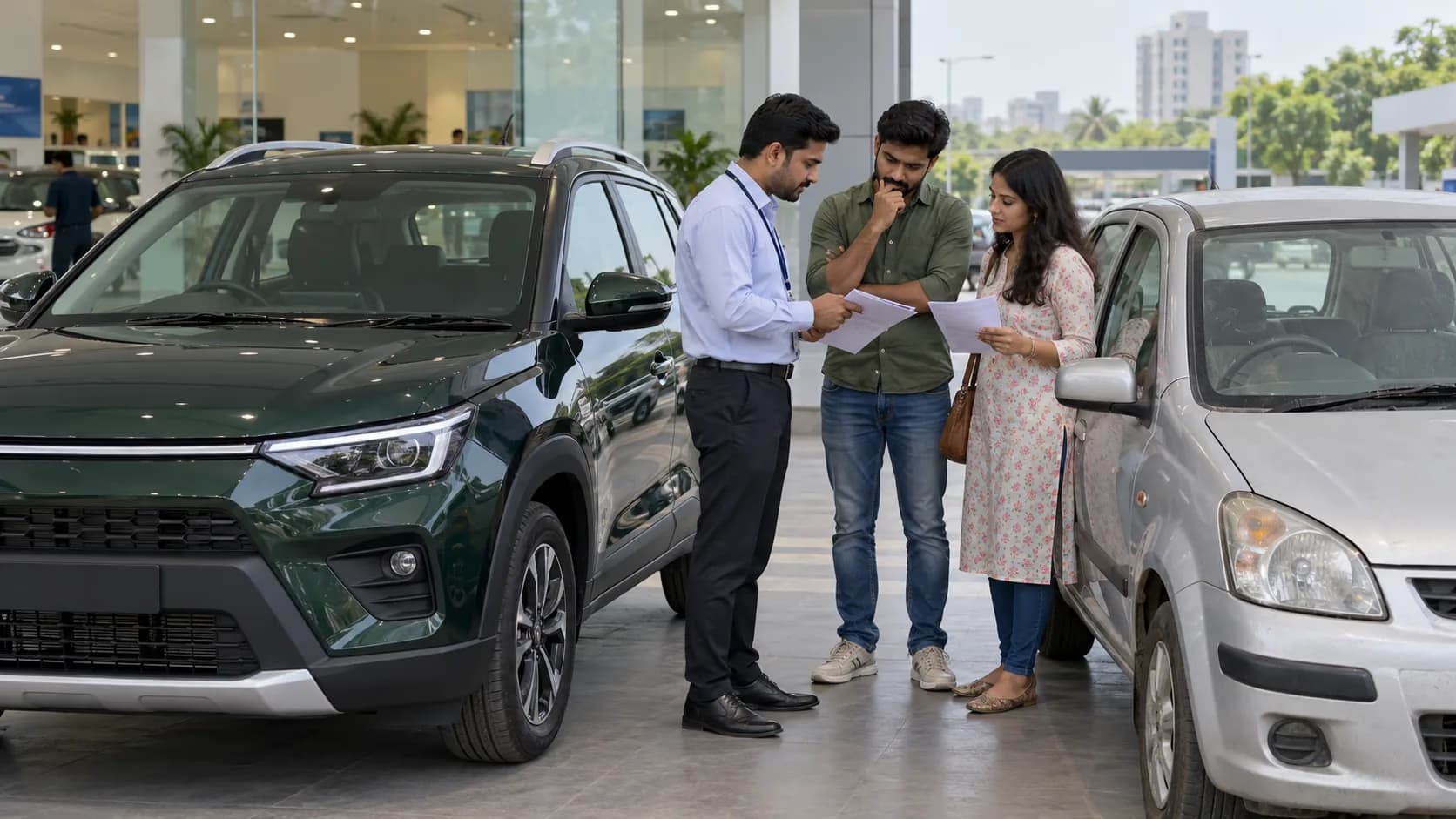
The dealer offers Rs 30,000 as an "exchange bonus" if you surrender your old car. It sounds like money added to its value. But if the trade-in valuation is Rs 40,000 below what another buyer will pay, the bonus has not made you Rs 30,000 richer. This is why a new-car exchange deal needs two separate calculations: the actual price of the new car and the actual proceeds from the old one.
Convenience has value. A single dealership can coordinate both transactions and reduce the time spent finding a buyer. The problem is treating that convenience as a reason not to see the numbers clearly. A fair exchange offer is one whose total cost you can compare with a separate sale, after fees and conditions.
Keep the two transactions visible
Ask for a written new-car quotation before the old car is assessed. It should show the on-road total, cash discount, manufacturer benefit, dealer concession, insurance, registration and optional products separately. Then obtain a stand-alone written trade-in valuation for the old car, including any deductions for tyres, paint, loan closure or repairs. Finally ask where the exchange bonus appears and whether it is conditional on the dealer buying that specific old car.
Do not accept a single net figure labelled "amount to pay." That figure can be reached by raising one line and lowering another. The numbers become meaningful only when you can recreate the calculation yourself. Ask whether the bonus applies to your selected variant, invoice month, model year and purchase channel. Offers can change; the date and terms on the written quote matter more than a poster at the showroom.
Compare a genuine outside bid
Get at least one independent offer for your old car, ideally after an in-person inspection. Online estimates are a starting point, not guaranteed sale proceeds. Give the same vehicle details, photographs and disclosed faults to each buyer. An outside offer that is conditional on a later inspection is not directly comparable with a dealer's final signed bid.
Use a simple comparison. Suppose a new car costs Rs 10 lakh after ordinary discounts. The dealer offers Rs 3 lakh for your old car plus a Rs 30,000 exchange benefit; your net outlay is Rs 6.7 lakh. An outside buyer offers Rs 3.35 lakh and you lose the Rs 30,000 exchange benefit; your net outlay is Rs 6.65 lakh. In that example the outside sale is still Rs 5,000 better, before transfer effort and any additional costs. The figures are illustrations, not market prices or a promise about any offer.
Now add the less obvious costs: collecting payment safely, clearing an existing loan, arranging ownership transfer and timing the new-car delivery. A Rs 5,000 difference may not justify a troublesome separate sale for everyone. A Rs 50,000 difference might. The point is that you choose knowingly.
Not every benefit stacks
One manufacturer's loyalty reward may exclude an exchange reward, and a scrappage benefit may require different proof than a regular trade-in. Maruti Suzuki's Rewards terms, for example, say eligible members cannot claim both an exchange bonus and an additional-car bonus on one purchase transaction. That rule belongs to that programme, not all brands; it illustrates why a salesperson's list of headline benefits is not automatically additive.
Ask which benefit is a cash reduction on the new-car invoice, which is applied through the trade-in transaction and which requires later documentation. Check whether accessories, insurance discounts or a service package have been counted as a "benefit" even though you might not buy them. A quoted benefit that is useful only with an unwanted add-on should not be valued like cash.
Protect the old-car handover
Get a written purchase acknowledgement for the old vehicle, including VIN, registration number, odometer, agreed price, payment date and responsibility for transfer. Do not hand over the keys and signed forms on a verbal promise that the new car will arrive next week. The seller remains exposed to questions about an old car until the ownership process is properly completed. Request proof that the transfer has been submitted and follow through to completion.
If the old car has finance outstanding, confirm the exact settlement amount with the lender rather than estimating the balance from your EMI schedule. Agree in writing who pays it, how any surplus reaches you and when the bank's release documents will be available. A dealer's trade-in number before loan settlement is not the cash you actually receive.
Do not let delivery timing erase the comparison
A separate buyer may want the old car today while the new car is weeks away. The cost of interim transport belongs in the comparison. Conversely, an exchange dealer may hold its valuation only for a limited time or reduce it when mileage increases. Ask how long the bid remains valid and what can change it.
Hyundai's online-booking terms note that promotions may have separately specified conditions and can change. Whatever brand you buy, obtain the current written offer with an expiry date and read the conditions before assuming a booking token locks every benefit.
Make the final decision from cash flows
Keep "free" add-ons out of the arithmetic
A dealer may offer accessories, a ceramic treatment or an insurance upgrade instead of a larger cash reduction. These have value only if you would have paid for them at the quoted price. Ask for the no-add-on quotation and check whether the original insurance quote was competitive. A package described as complimentary may already be absorbed in a weaker trade-in valuation.
Similarly, a scrappage benefit is not the same as a normal exchange bonus. It may require proof that the old vehicle goes through an authorised scrapping process, and its paperwork and payout timing can differ. Get the exact offer terms for the car and date you are buying; do not borrow a headline from another state, model or month's advertisement.
Negotiating without losing the trail
If the dealer improves the exchange price after you show an outside bid, ask for a revised written quotation with each line updated. A verbal promise that a manager will "adjust it in insurance" makes later checking difficult. Keep copies of both the original and final quote. Confirm whether the old car's valuation remains valid if the new car's delivery slips or if its odometer rises before handover.
Before surrendering the old car, remove personal items and clear paired phones or saved addresses from the infotainment system. If it has a connected-car account, complete the manufacturer's unenrolment process separately. The trade-in paperwork transfers a physical vehicle, not necessarily its app permissions. Keep a copy of the signed handover and photograph the odometer and condition on the day the dealer takes possession.
Write three numbers on one page: new-car outlay without any trade-in, net amount from an independent old-car sale, and net amount from the dealer exchange including only confirmed benefits. Adjust for transfer, loan and timing costs. This is a more reliable guide than a large "total savings" badge. The better deal is the one with the lower real outlay and manageable transaction risk, not necessarily the one with the biggest bonus in its advertisement.