A freshly detailed used car can still carry evidence of an old flood below the carpet or inside its connectors. The seller may honestly not know its full history, especially if it has passed through several owners or dealers. The goal of an inspection is not to label every damp car a flood write-off. It is to spot inconsistent evidence early enough that you can commission a proper check or walk away before paying.
Begin with the story of the car
Ask where the car spent the monsoon seasons, whether any insurance claim involved water ingress, and whether carpets, control units or wiring have been replaced. Request service and repair invoices rather than accepting a verbal explanation. Compare the registration and vehicle identification number on the paperwork with the car. A history gap does not prove flooding, but an unexplained carpet replacement, repeated electrical faults or a car moved from a heavily affected area should prompt closer inspection.
The US road-safety agency NHTSA's buyer guidance warns that water-damaged cars may look normal after cleaning and that effects can appear much later. Its advice to look for mud, waterlines, odours and corrosion applies as an inspection principle; its US vehicle-title system does not map directly to Indian registration records. Avoid relying on a foreign "salvage title" check as though it were a complete Indian history report.
Inspect places a quick valet misses
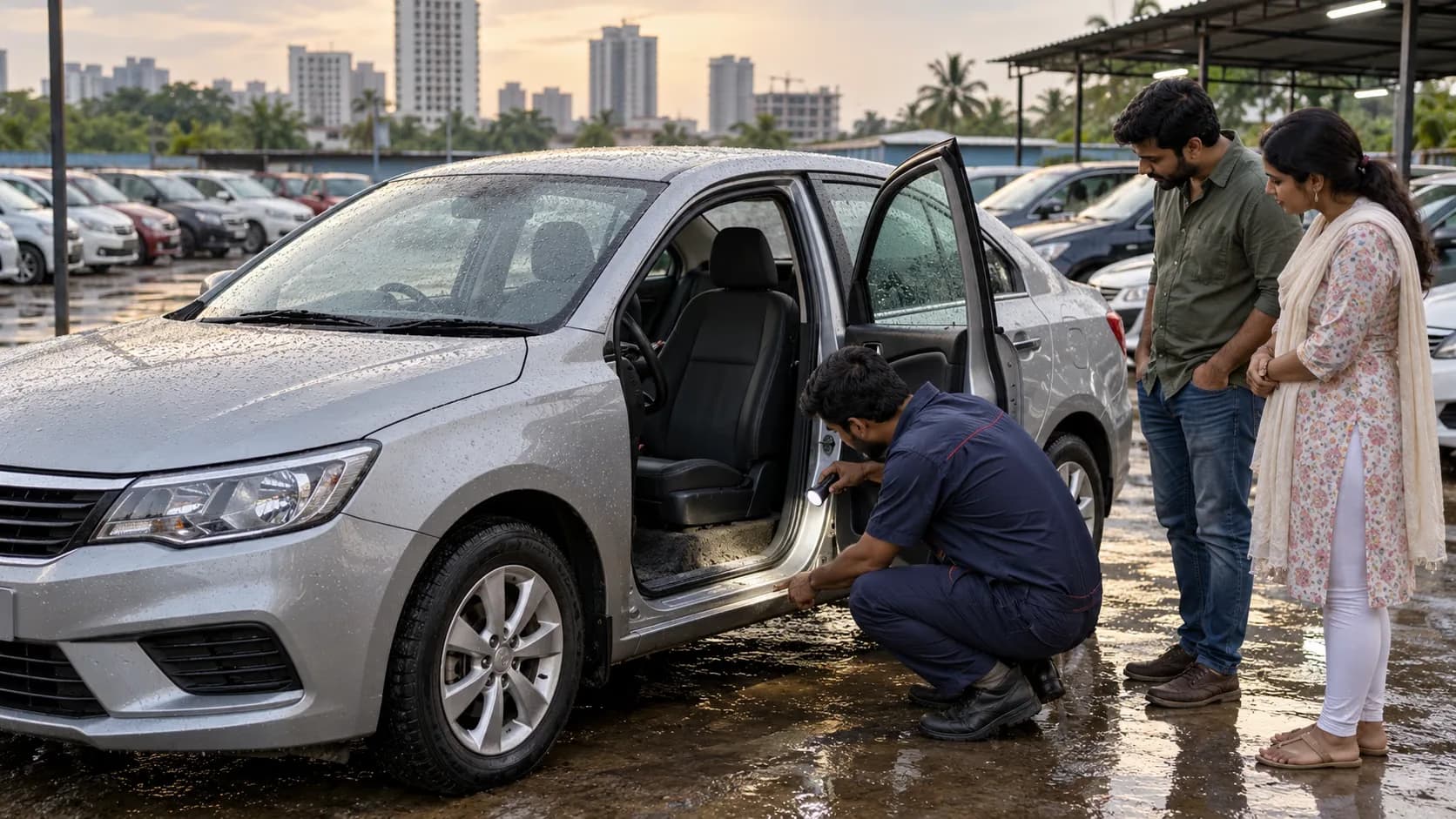
With the owner's permission, look beneath loose floor mats and at the edges of the carpet. Check the boot well, under the spare wheel, inside the glovebox and at the lower edges of the door trim. Compare exposed screw heads and seat rails with the surrounding interior. Silt caught in a concealed corner, a high waterline or unusually widespread corrosion is more revealing than a polished dashboard. Autocar India's used-car flood guide specifically points buyers toward hidden unpainted metal and seat-rail hardware.
Use your nose, but do not make it the verdict. A persistent musty smell can indicate trapped moisture; heavy perfume can mask it. Either may also have an ordinary explanation. Combine smell with visible evidence and documents. Look for condensation inside lamps and signs of water in hard-to-clean cavities. Do not dismantle trim yourself on a seller's car or damage any electrical connector in the search for proof.
Electrical behaviour matters more than a clean test drive
Water can affect connectors and modules intermittently, which is why a short drive may be unremarkable. Check every window, lock, mirror, seat adjustment, exterior lamp, infotainment function, camera, parking sensor and climate control in the exact car. Start it from cold if possible. Watch that warning lamps illuminate and extinguish as the manual describes. Have a qualified workshop scan relevant modules for current and stored faults; a generic engine-only scanner can miss body and safety systems.
Ask the inspector to examine accessible connectors and grounds for corrosion under the maker's procedure. Do not spray contact cleaner into an unknown module or accept a casual explanation that all errors are "old battery codes". A single historical fault can be harmless, but a cluster of communication errors across unrelated systems deserves a deeper diagnosis. Water exposure can also affect seat-belt pretensioners and airbag electronics, so a restraint-system warning is a safety issue, not just an annoyance.
Put the car on a lift
Underside inspection helps separate ordinary road grime from unusual deposits, damaged covers or widespread corrosion. The workshop can check wheel bearings, brakes, suspension joints and the underbody while comparing their condition with the car's age and claimed use. A coastal car or one driven on salted roads can also show corrosion, so no single rusty fastener proves submersion. What matters is the pattern, depth and consistency of evidence across the cabin, engine bay and underside.
If it is an EV or hybrid, use a specialist familiar with that model. Do not poke around its traction-battery enclosure or orange high-voltage wiring. NHTSA cautions that a flooded electrified vehicle can present electrical hazards; the appropriate assessment belongs with trained personnel. Do not start a suspected recently submerged vehicle merely to see if it runs.
Do not confuse ordinary wear with water damage
A rusty exhaust component is not the same evidence as silt beneath a dry, recently fitted carpet. Older cars have legitimate repairs, and a blocked AC drain can wet a footwell without a flood. Ask a workshop to identify the water source and the affected height, not merely to write "water damage" on a generic checklist. Evidence becomes stronger when several independent signs align: cabin water marks at a similar height, corrosion on hidden fasteners, mud in the boot well and unexplained faults in low-mounted modules.
Recent upholstery work can be a clue, but there are benign reasons to replace seat covers or carpeting. The useful question is whether the seller can show a matching invoice and explain why the work was done. Look at both sides of the car and the boot, because local leaks can affect one area while deeper immersion usually leaves a broader trail. A knowledgeable inspector should also note what could not be checked without removing panels, so you do not mistake a limited inspection for certainty.
Negotiate only after estimating the risk
If a problem is found, ask for a written repair estimate and the shop's view on whether it can verify long-term reliability. Replacing a wet carpet is not the same as repairing corroded wiring or safety electronics. Price the whole diagnosis, not just the visible cleaning. Insurance and warranty coverage on a pre-owned car should be checked in writing before purchase; do not assume a seller's informal assurance transfers into a future claim. When the unknowns are greater than the discount, the rational move is to leave the car behind.
Decide what evidence would change your mind
Some owners disclose a minor cabin leak that was found and repaired, with invoices and no recurring symptoms. That is different from an undocumented car showing silt in multiple hidden spaces and intermittent electrical faults. Ask the seller for the repair record, an independent inspection and a realistic explanation of the findings. If those are unavailable, a low asking price should not make the uncertainty disappear.
Do not put down a non-refundable booking amount before the inspection. Put any important seller representations in writing and ensure the vehicle identification details match the documents. For a financed car, remember that a repair problem does not cancel the loan obligation. The US Consumer Financial Protection Bureau makes that broader financing point in its flood-car buyer advice; Indian contract terms will differ, so review your own lender agreement.
The sensible threshold for walking away
There is no reliable "one trick" that can certify a used car as flood-free. Instead, build a picture from the records, hidden physical signs, electronics and a qualified inspection. If the seller resists an independent check, the documents conflict or a workshop finds water-related damage that has not been fully repaired, find another example. Used-car supply is large enough that you need not buy uncertainty dressed up as a discount.
Take photographs during the inspection and keep the written report. If you do buy, those records help you understand the condition at sale and maintain the car. More importantly, a careful process protects you from discovering a hidden electrical or safety problem only after the monsoon has long passed.