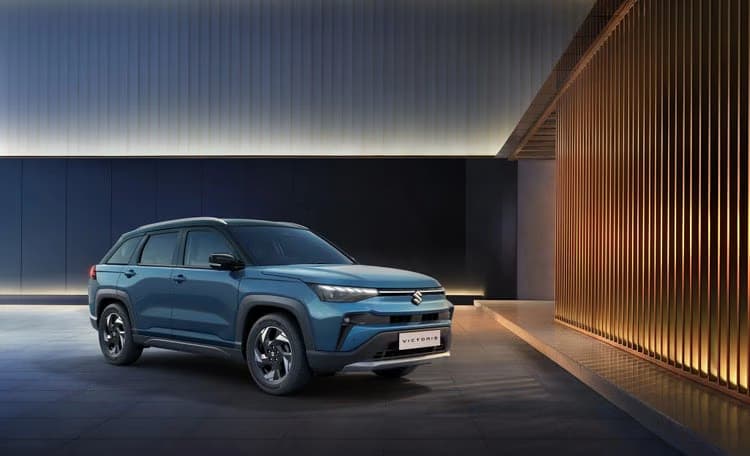
The Maruti Suzuki Victoris gives a buyer three ways to reduce fuel spending without choosing a diesel. Two of them—the S-CNG and the strong hybrid—can look equally sensible on a brochure. They solve different ownership problems, however. One asks whether reliable CNG access and a manual gearbox fit your routine. The other asks whether you are prepared to pay more up front for an automatic that saves petrol in its own way.
Maruti's official Victoris brochure lists the S-CNG with a five-speed manual and the strong hybrid with an eCVT. Those are not minor details hidden behind the fuel-economy numbers. A buyer who must have an automatic has already narrowed this particular comparison. Equally, someone who can fill CNG conveniently and wants to keep the purchase price in check may have no reason to pay for the hybrid system.
First locate the fuel stop, then compare the car
CNG ownership works best when refuelling is on an existing route. A station that looks close on a map may take a detour, have queues at the time you commute, or sit on the wrong side of a divided road. Visit it at the time you would actually use it. Ask how frequently it is open and consider a second station on a regular highway journey. The Victoris can also run on petrol, but buying the CNG version and using petrol most of the time defeats the expected running-cost benefit.
The strong hybrid uses petrol and does not need an external charging point. Its battery is charged by the car while driving and braking, with the engine and electric motor managed automatically. That makes it simpler for a family whose routes change often or who cannot depend on CNG availability. It still needs ordinary petrol stops, and its efficiency will vary with speed, traffic, terrain, weather and driving style. Do not treat a laboratory-cycle figure as your personal monthly result.
Do not compare kilometres per litre with kilometres per kilogram
Maruti quotes an official 27.02 km/kg for the S-CNG and 28.65 km/l for the strong hybrid in its launch specification. The units are different. Saying one number is larger therefore one car is cheaper to run would be a basic error. You need the price per kilogram of CNG and per litre of petrol where you actually fill, and a realistic consumption estimate for your own route.
A useful calculation is simple. Divide your local CNG price per kilogram by a conservative CNG km/kg figure to estimate fuel cost per kilometre. Do the same with petrol price per litre and a conservative hybrid km/l figure. Multiply each by your expected yearly kilometres. Then add the purchase-price difference, finance interest, scheduled maintenance, insurance and any extra time spent refuelling. Recalculate if you move city or your commute changes. The number that matters is a range of plausible costs, not a single precise-looking saving built from ideal test figures.
A short city commute can favour the strong hybrid's ability to shut its engine off in some conditions, while a predictable high-mileage route with easy CNG access can make the CNG case stronger. Those are tendencies, not a promise of a particular real-world result. Ask the dealer for the exact variant and, if possible, speak to owners with routes like yours before treating an annual saving as guaranteed.
The boot deserves a real luggage test
Many factory CNG cars sacrifice a large part of the luggage bay to a cylinder. Maruti positions the Victoris differently: its S-CNG uses an underbody tank arrangement, which the manufacturer says helps preserve usable luggage space. That is a genuine reason to inspect the Victoris rather than dismissing it using a generic CNG assumption. It does not mean every boot dimension or loading shape is identical across the two powertrains.
Take the pram, suitcase or wheelchair you need to carry and test both cars in person. Check the boot floor, spare-wheel provision, loading lip and how the rear seats fold in the exact variants. If you routinely need a full family load plus roof luggage, check the permitted payload and roof-load limits too. A brochure's nominal capacity cannot tell you whether a rigid suitcase fits past the opening.
Manual versus automatic may settle it
The CNG Victoris has a manual gearbox. If your daily journey is a long crawl in traffic, the effort of clutch work has a real value even when it is absent from a spreadsheet. The strong hybrid's eCVT changes that routine. Drive it in the traffic conditions you face, then take it onto a faster road and see whether its response and sound suit you. Do not use a short loop around the showroom as the whole verdict.
Likewise, the CNG car should be driven in CNG mode as well as petrol mode. Maruti's official figures show different engine output depending on fuel. Take the passengers and luggage you normally carry, find a safe incline, and judge whether the response is comfortable. A perfectly adequate solo test drive can feel different with five people and luggage aboard.
Check the exact variant before discussing a deal
Equipment differences can be larger than the fuel-system difference. List the safety and convenience features that matter to you, then compare only the actual S-CNG and strong-hybrid variants available in your city. The official brochure is useful for this, but the dealer's written quotation should specify model year, trim, transmission, colour, insurance and any accessory package. Do not use a feature seen on a top-spec display car to evaluate a lower-spec car you will receive.
Ask about the separate warranty terms for the hybrid battery and the CNG system, as well as the regular vehicle warranty. Record the service intervals and the nearest authorised service outlet equipped for the chosen powertrain. A used-car buyer will later care about documented servicing, so keep invoices and any system-specific inspection records.
Make the choice around your constraints
Choose the S-CNG if convenient CNG supply, a manual gearbox and your annual mileage make a persuasive whole-cost case. Choose the strong hybrid if an automatic and refuelling flexibility matter more, and the up-front premium still makes sense over your intended ownership period. If neither case is convincing, the regular petrol Victoris belongs in the comparison as well. Three quotations, driven on the same route, will tell you more than a single claimed mileage number.
See the verified Victoris model page for the car's overview. Confirm the latest variant matrix and prices with Maruti Suzuki before ordering. Cover photograph: Maruti Suzuki.