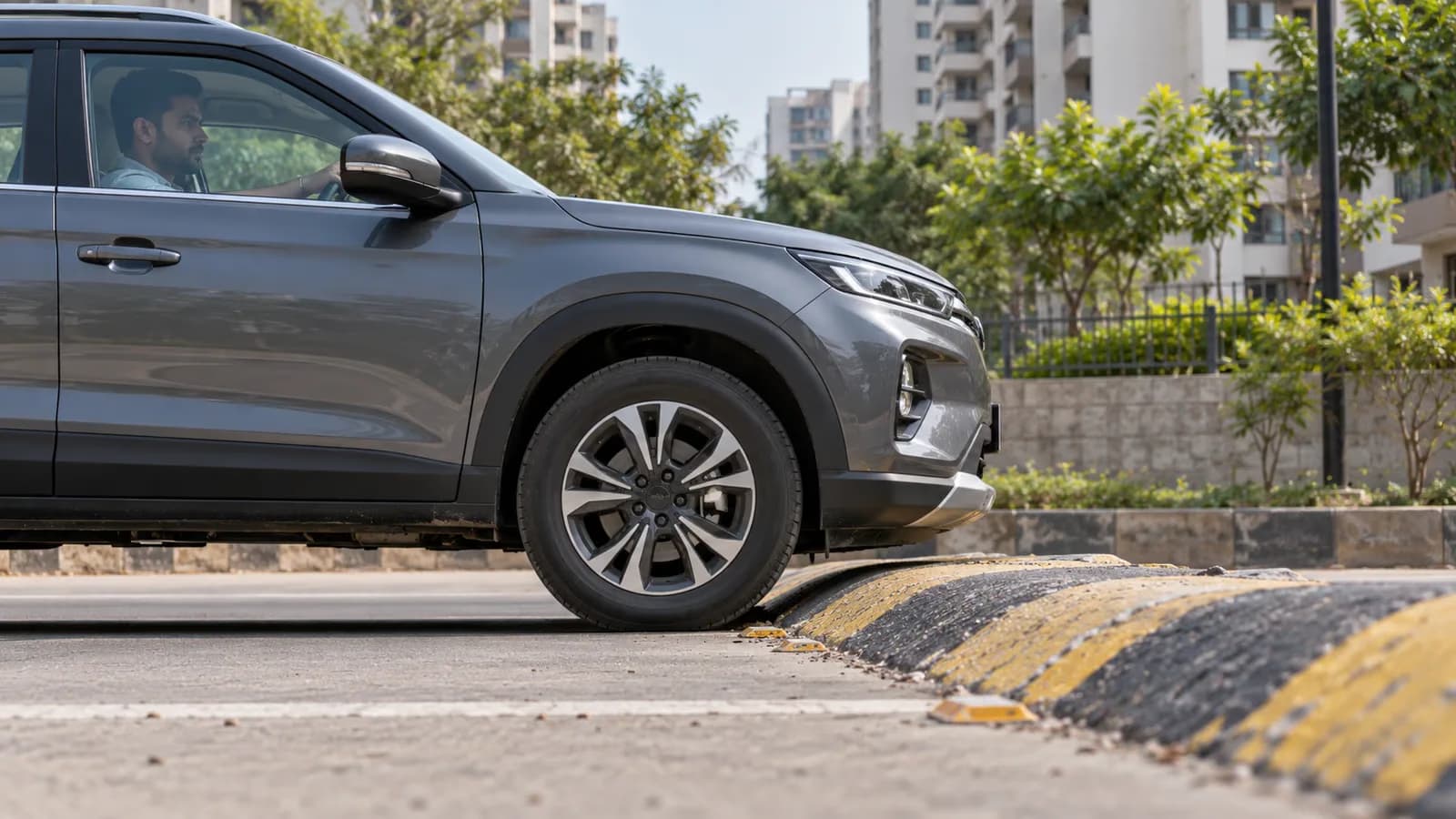
Two cars can quote much the same ground clearance yet behave differently at a steep basement entrance. One clears the ramp. The other touches its front lip before the wheels have begun climbing. The missing detail is not always extra height beneath the car. It may be the distance from the tyre to the bumper, or the distance between the two axles.
Approach, departure and breakover angles describe those different contact risks. They are useful for buyers who use sharp parking ramps, uneven village roads or broken access tracks. They are also a reminder that an “SUV stance” in a photograph is not a measurement.
What ground clearance does, and does not, tell you
Ground clearance is the vertical gap from the ground to a specified low point beneath a vehicle. It is useful, but the quoted figure depends on how it was measured. Passenger load, tyre size, tyre pressure and suspension compression can change the real space underneath. The vulnerable part might be an undertray, exhaust component or battery protection, not the centre you expected.
A car that crosses a speed breaker when empty might touch it with five people and luggage aboard. That is not necessarily a contradiction of the brochure. Ask how the manufacturer states its clearance, inspect the actual variant and test the obstacle under a representative load where doing so is safe.
Approach angle: the nose of the car
The approach angle is a way of describing the steepness of an obstacle the front can meet before the nose is likely to touch. A long, low front overhang reduces the practical angle even when the middle of the car sits fairly high. A steep ramp, a deep drain crossing or a raised track can all expose this weakness.
Watch which part touches on your present car. If it is a bumper lip at the start of a ramp, choosing a taller car by clearance number alone may not solve the problem. Look at its front overhang and nose shape. A slow, straight approach helps you observe the vehicle, but do not take a wide diagonal line into pedestrians or traffic just to save a bumper.
Departure angle: the tail on the way out
The departure angle applies the same idea behind the rear wheels. A car may enter a driveway without trouble and scrape its rear bumper when leaving. Tow hitches, steps and accessories can make the rear overhang more vulnerable. Check the car in the specification you will actually use, with any planned accessory fitted, not only a pristine display car.
Jeep's explanation of off-road terms distinguishes approach and departure angles from ground clearance. It is a helpful geometry reference, not a promise that a given Jeep or another vehicle can cross your particular ramp.
Breakover angle: the risk at the middle
The breakover angle describes whether the underbody may touch the crest of an obstacle while the wheels are on either side. Wheelbase matters here. A long car can have a reasonable clearance figure yet sit on a sharp crest that a shorter car passes. An abrupt speed breaker, driveway crown or rural track can create the problem even far from an off-road trail.
Do not assume a flat EV floor can safely be used as a skid plate. Battery enclosures and their protection have specific design limits. If an underbody strike occurs, check the manufacturer's guidance and seek inspection, especially when a warning appears. Similarly, plastic shields on combustion cars can conceal components that deserve a look after a hard impact.
How to compare cars against your own road
- Identify the actual obstacle: a parking-ramp lip, a tall breaker, a crest, or a deep rut.
- Record whether your current vehicle contacts at the front, middle or rear. A safe external photograph can help.
- Inspect the candidate's bumper shapes, wheelbase and lowest visible underbody components as well as its stated clearance.
- Check the exact variant, tyre size and any accessories. Different trims can change the geometry.
- Where practical, test the route slowly with a dealer representative, keeping people away from the vehicle's path.
A brochure may omit these angle figures entirely. That makes a careful physical inspection and route-specific test more valuable, not less. Ask the dealership whether it can demonstrate the car on a representative ramp. If not, look at the front and rear overhangs and treat the result as uncertain rather than assuming the extra millimetres will fix everything.
Angles are not the whole off-road story
Tyre grip, suspension travel, vehicle width, driver visibility and the road surface all affect whether a route is sensible. A vehicle can have excellent geometry and still lack traction on wet clay. Standing water can hide holes, and a muddy shoulder can collapse under load. No angle figure tells you that the surface ahead is safe.
For ordinary city driving, cabin access, ride quality and parking size may be more important than pursuing the largest possible approach number. The point is to solve the particular obstacle you meet. A compact car with short overhangs may be a better answer than a longer, higher-looking SUV. Clearance begins the conversation; the three angles explain why it cannot end there.
What a car brochure may leave out
Some brochures provide only the unladen clearance number and omit the approach, departure and breakover angles. Ask whether the published value is measured with a defined load and whether a tyre or suspension option changes it. A sports-style bumper on a higher trim can reduce practical approach clearance while the underlying chassis remains the same. A larger wheel may alter the stance, but the tyre's overall diameter, suspension tuning and bodywork also matter. Do not infer an improvement from alloy-wheel size alone.
Look at the underbody from a safe position during a showroom inspection. The visible lowest point may be a protective part, but its presence still tells you where contact could occur. Avoid crawling under an unsupported vehicle. If you are planning a tow bar, step or decorative bumper guard, discuss the additional protrusion before installation. These accessories are often omitted from factory geometry figures.
Reading the obstacle, not just the car
A ramp with a sharp transition at each end can create separate problems: the front touches on entry, the centre touches at the crest and the rear touches as the vehicle exits. The slope itself may be manageable; the abrupt change in slope is the culprit. A broad speed breaker with gentle edges is different from a narrow, tall one even if both reach the same maximum height. Deep ruts add another complication because the wheels can sink while the central surface remains high.
Think about the route at night and in rain, when you may not see the high point clearly. A guide walking outside can help in a private, low-speed setting, but only if they can stand safely clear of the path. Do not attempt a trial where the car might block traffic or where the obstacle conceals a dangerous drop. The cost of a different route is often less than an underbody repair.
What to do after a scrape
A light plastic scuff and a hard impact underneath are not equivalent. Stop where safe and check for leaking fluids, hanging shields, new noises or warnings. If the car behaves abnormally, avoid continuing the journey and seek inspection. Even a small contact can dislodge an undertray that later catches air or road debris. If a battery-electric vehicle has suffered an underbody impact, follow its specific manual guidance and do not dismiss a new battery warning as cosmetic.
Keep a note of which part contacted and under what load. That information is useful when comparing your next car, and it is more precise than telling a salesperson that the old one “had low ground clearance”.