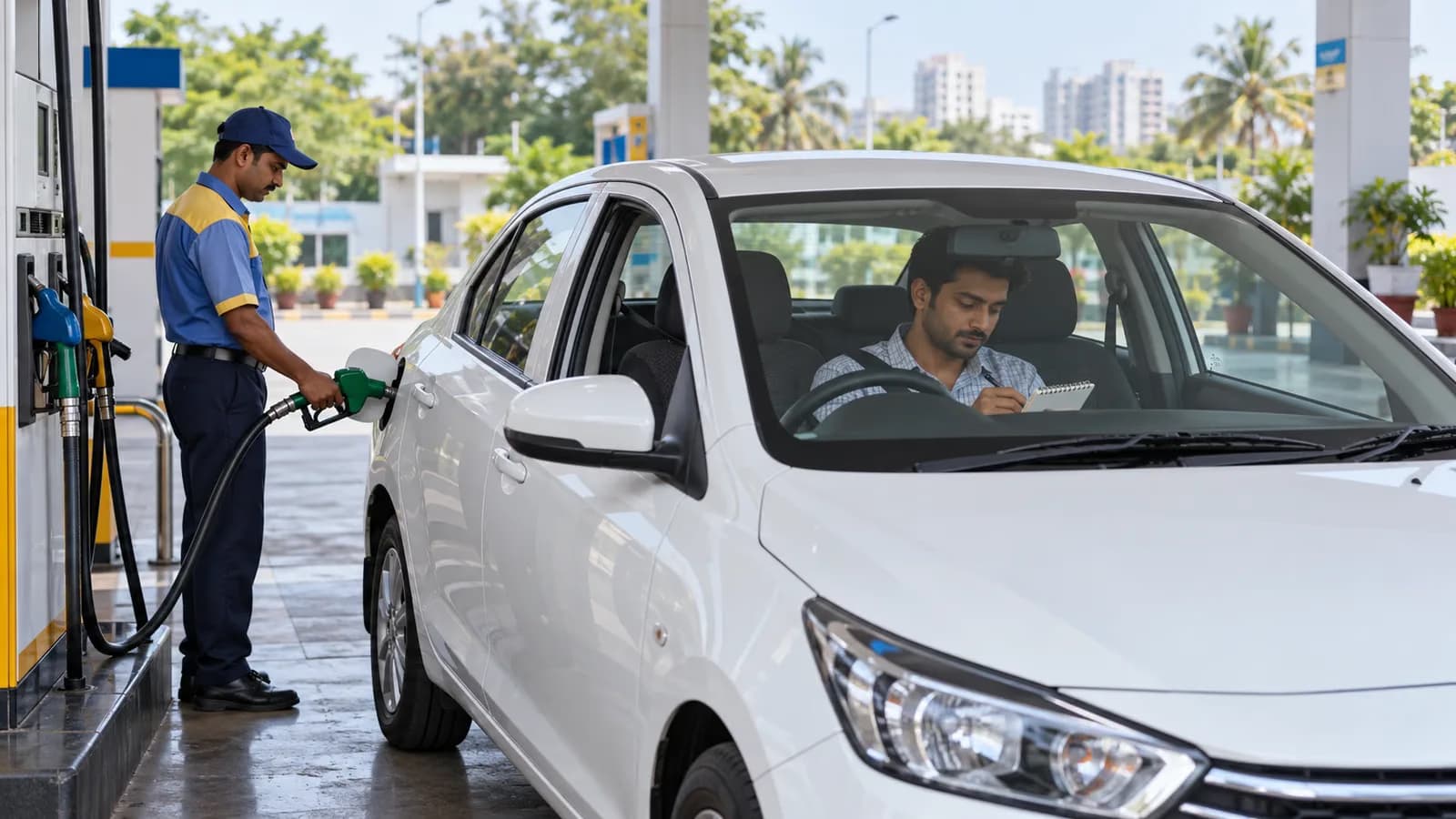
“What mileage does it give?” sounds like a question with one number for an answer. In practice, the dashboard readout, the fuel-station receipt and a manufacturer's test figure measure different things. A drive through free-flowing traffic with the AC off will not match an hour spent crawling through a hot city. Even two tanks filled at different pumps can give different one-off calculations.
A useful mileage record is therefore not a contest to obtain the highest number. It is a repeatable way to understand what your car consumes on the route you actually drive, and to spot a meaningful change when the driving conditions have stayed similar.
What the trip computer can tell you
The multi-information display, or MID, estimates fuel economy from the vehicle's own data. Depending on the car, it can show instantaneous consumption, trip average and a longer-running average. Instantaneous readings swing sharply when you accelerate, coast or idle. They are useful for learning which actions affect fuel use, not for telling you what a whole month costs.
A trip average is only as meaningful as the distance since it was reset. A few minutes of downhill travel can look impressive; an engine idling after a reset can look alarming. Before comparing readings, note when each trip was reset and whether the routes, traffic, load and AC use were alike. Do not judge another driver's car against yours from a single dashboard photograph.
How to make a tank-to-tank log
- At a fill-up, record the odometer reading and fuel quantity on the receipt.
- Use a consistent fill practice at the next stop. Do not force extra fuel into the neck after the pump stops.
- At the next comparable fill, subtract the earlier odometer reading from the new one to get distance travelled.
- Divide that distance by the litres added at the second fill to obtain a rough kilometres-per-litre result.
- Repeat across several fills. Add all distances and all litres before dividing for a more stable average.
The single-fill method assumes the tank ended at approximately the same level on both visits. Automatic pump cut-off can vary with pump nozzle, slope and filling rate, so one result can be noisy. A multi-fill log smooths that variation. If you switch between several fuels, record them separately rather than blending incomparable figures.
Why real use varies
The US Environmental Protection Agency explains that speed, acceleration, idling, weather, terrain, cargo and maintenance all change fuel economy. Its test regime is for the United States and should not be mistaken for an Indian certification method, but the underlying lesson is broadly useful: a laboratory comparison figure is a standardised yardstick, not your personal route's guaranteed result.
Short trips may spend a larger share of time with a cold engine. Stop-start traffic can add long periods of idling to a small distance travelled. Tyre pressure, excess cargo and roof accessories can also affect consumption. A hybrid may behave differently from a conventional petrol car in city traffic because its electric assistance and energy recovery operate there. These effects are reasons to compare like with like, not excuses to ignore an unexpectedly large change.
Why the two numbers need not agree exactly
The dashboard and the receipt rely on different inputs. The MID uses vehicle measurements and software estimates. The tank method uses pump litres and odometer distance. A small discrepancy does not automatically imply a fault, cheating at the pump or an inaccurate odometer. Compare several tanks before drawing conclusions, and avoid constantly resetting the MID at convenient moments.
Also check whether your display is showing kilometres per litre or litres per 100 kilometres. In one, a higher number indicates lower fuel use per kilometre; in the other, a lower number does. Range-to-empty is another estimate that changes with recent driving. It should not be treated as a promise that the car will travel exactly the displayed distance before running out.
When a drop deserves investigation
If your multi-tank average deteriorates despite similar routes, traffic and loads, check obvious variables first: tyre pressures measured cold to the car's specified value, service schedule, dragging brakes, warning lights and recent changes in fuel or driving pattern. Do not pay for a speculative sensor replacement on the strength of one dashboard reading. Explain your log and the conditions to the workshop so it can reproduce the concern.
A sudden fuel smell, leak, misfire, overheating or warning light needs prompt professional attention rather than mileage experimentation. Keep receipts and dated readings; they are more useful than relying on memory after a problem has grown.
Using the number when buying a car
Compare official economy figures between cars as a common baseline, then use independent road-test results with matching routes and methods to assess likely real-world variation. Remember that different drivers, tyres and weather can change those results too. During your own test drive, focus on ergonomics and powertrain response. A brief test route cannot establish dependable lifetime mileage.
For a monthly budget, estimate your actual kilometres, pick a cautious consumption assumption and keep room for variation. A transparent log over several fills will tell you more about your own car than a perfect-looking instantaneous number. The goal is not to win a screenshot; it is to know what your driving really costs.
Worked example without false precision
Suppose you travel 420 km between two reasonably comparable full-tank stops and add 30 litres at the second stop. The simple calculation is 420 divided by 30, or 14 km per litre. If the next fill cuts off earlier than usual, that individual result may be misleading. Combine several fills: for example, 1,250 km over a total of 90 litres is about 13.9 km per litre. That broader average is usually a better planning number than one unusually strong or weak tank. The numbers here only illustrate the arithmetic; they are not the tested result for any car.
Use the receipt's actual litres rather than the fuel gauge segments. Fuel gauges are intended to indicate approximate remaining fuel, not to serve as precise measuring instruments. Likewise, do not run the tank near empty just to complete a test. Refill at a sensible level and keep the process consistent.
City versus highway comparison
If you want to understand two routes, record them separately over multiple trips. A city week with long traffic lights and short journeys can use more fuel per kilometre than a steady road trip. A high-speed highway run can also be less efficient than a moderate-speed one because aerodynamic drag rises as speed increases. The simple “highway is always best” assumption is too broad. Check your car's own results while keeping speed legal and safe; do not alter driving behaviour to chase a display number.
For a household using more than one driver, note who drove and any major load difference. You do not need an elaborate spreadsheet: date, odometer, litres, fuel type and a short route note are enough. A phone note or receipt envelope works. The method matters more than the app.
Using an MID honestly on a test drive
Ask the dealer when the display was last reset. A demonstration car that spent hours idling with the AC on may show an extremely low average; one reset just before a short downhill stretch may show an implausibly high one. Neither tells you what a year's ownership will look like. Treat the displayed number as a prompt to ask about the route and driving conditions, not as a purchase decision on its own.
Fuel price can change while your consumption remains the same. Keep litres-per-kilometre thinking separate from rupees-per-kilometre budgeting. When comparing petrol, diesel, CNG or hybrid options, add purchase price, service, insurance and your actual annual distance. A small difference in displayed mileage may be much less important than the financing or usage pattern.