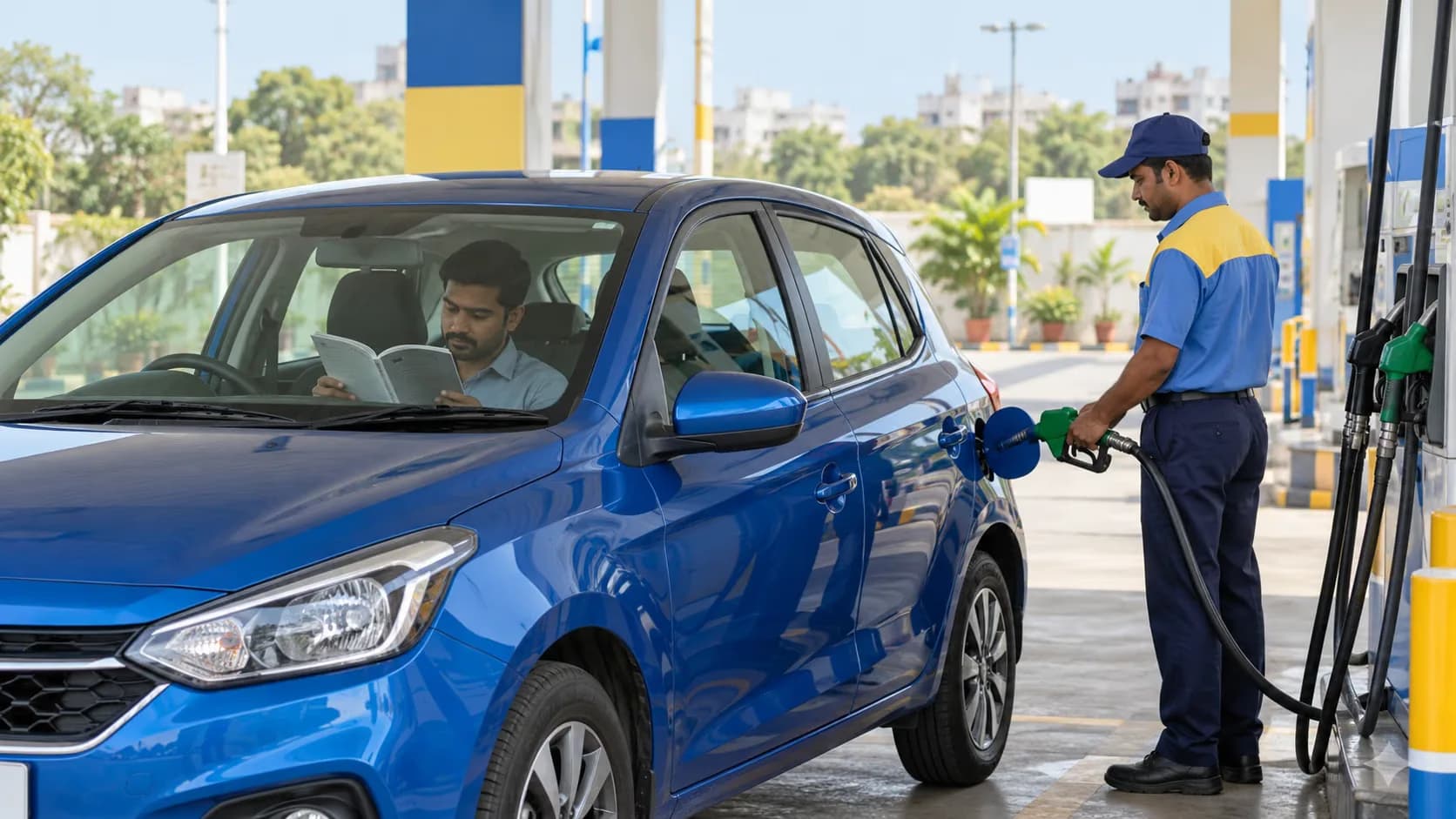
A petrol pump offers regular, premium 95 and sometimes 100-octane fuel. The attendant asks whether the more expensive nozzle is "better for your engine." The answer is in your car's fuel requirement, not in the name on the dispenser. Octane rating describes resistance to knock; it is not a measure of cleanliness, energy content or a universal promise of more kilometres per litre.
There is an added Indian wrinkle in 2026: the mandated E20 petrol specification has changed the baseline octane discussion. Older articles and even older oil-company pages may describe regular petrol as 91 RON. A buyer should avoid comparing today's pump choices using yesterday's assumption, while still following the fuel requirement and ethanol compatibility of the exact vehicle.
Start with RON in the owner's manual
Open the fuel section for your exact model year and engine. It may state a minimum Research Octane Number, or RON, and sometimes give a different number in the US Anti-Knock Index, AKI. Those numbers are not interchangeable labels for the same test. A Hyundai Tucson manual, for example, specifies unleaded fuel at RON 91 or higher for the petrol engine covered by that document. That is an example, not a recommendation for every Hyundai or every new Tucson.
Some engines require or recommend a higher grade to achieve rated performance. Others are designed to run normally on a lower minimum and may gain little from a dearer fuel. If the manual says "minimum," meeting it is the first question. If it says "recommended for maximum performance," the owner has a different choice. A dealership's casual "all turbo cars need 100" is too broad.
What India changed in 2026
The Government of India's 2026 E20 explainer says petrol sold across India from April 2026 is mandated to contain 20% ethanol and meet a minimum 95 RON. That is a current specification claim, not proof that every dispenser everywhere has the same additive package or that old 91-RON descriptions remain current. If you see contradictory information, check the latest official fuel specification and the pump's product label.
Do not confuse octane with ethanol compatibility. A car whose manual permits a certain RON is not automatically approved for every ethanol percentage. The fuel recommendation may specify both. An older car can need one answer about knock resistance and a separate answer about permitted blend. Ask the manufacturer using the VIN if the manual is unclear.
Higher octane is not an octane deficit cure
Octane helps a petrol engine resist premature combustion under pressure. An engine management system may be able to take advantage of a higher grade under certain loads and calibrations; another engine may show no meaningful difference in ordinary traffic. The possibility is not a guarantee of improved mileage or acceleration for your car. A claim from a fuel supplier is not a substitute for vehicle-specific evidence.
IndianOil describes XP95 as a 95-octane product and advertises potential performance benefits depending on model. Read those as product claims with conditions, not a fixed saving you can put in your monthly budget. For an owner whose car already meets its minimum with regular fuel, the extra cost needs a measurable benefit to be economical.
Calculate cost per kilometre, not just kilometres per litre
If premium petrol costs more per litre, a small mileage improvement may still leave each kilometre more expensive. Fill at the same reliable station, record litres and distance over several comparable tanks, and calculate total rupees divided by distance. Traffic, weather, tyre pressure, route and driving style can swamp a small difference. The dashboard's displayed fuel economy is not enough for a one-tank verdict.
Use the same method for both fuels and avoid running the tank unusually low to make a test work. Do not claim a car "felt smoother" after ten minutes as proof of a chemical benefit; expectation and changing conditions affect perception. If the manual requires a higher grade, the question is compliance, not whether the premium pays for itself in mileage.
100 RON is a separate purchase decision
IndianOil markets XP100 as a 100-octane fuel aimed particularly at high-performance applications. That does not mean every petrol hatchback benefits from it. Check availability, price, the manufacturer's recommendation and whether the engine is designed to use extra knock resistance. Avoid mixing this with an unrelated discussion about whether a particular petrol blend is compatible with an older fuel system.
Fuel additives have their own specifications. The higher octane number alone does not prove an aftermarket bottle of cleaner is needed. Many manuals warn against unspecified additives. If an engine knocks, hesitates or shows a warning light, diagnose it; repeatedly switching to an expensive fuel may mask rather than resolve the fault.
What to ask at a pump
Identify the product's displayed RON and blend, and keep a receipt if you are comparing fuels. Use a reputable outlet. Never accept diesel or any unidentified fuel because the nozzle was handed to you by mistake. If the station cannot tell you what is being dispensed, choosing a clearly labelled, manufacturer-compliant product elsewhere is a sensible response.
RON is not a quality grade for the whole fuel
Two fuels with the same RON can differ in additive package, price and blend specification. The number does not tell you everything about deposit control, storage or energy per litre. It primarily answers a knock-resistance question. This is why a pump's "premium" label should be read with its actual product specification rather than treated as a single ladder from bad to good.
If you see an AKI value from an imported manual or a US video, do not compare it directly with an Indian RON label. AKI uses a different calculation. The owner's manual often prints both values for different markets. Use the value specified for your region and engine rather than converting casually from an internet comment.
When to stop experimenting
If the engine develops knocking, rough running or a warning after refuelling, keep the receipt and seek diagnosis. The cause might be fuel quality, but it could also be ignition, sensing or another fault. Do not run multiple tanks of expensive fuel as a substitute for checking a persistent problem. Likewise, do not add an octane booster unless the vehicle maker approves it; an unknown additive introduces another variable.
For a used performance car, the safest way to learn its required fuel is a manufacturer manual for its exact engine and market, backed by service records. A badge on the boot or a seller's memory is not enough. Fuel choice is a maintenance decision, not a lifestyle accessory.
When comparing fuel bills, use actual price per litre on the dates you filled. Premium and regular price gaps can change, so an old comparison may no longer hold. If your usual station no longer stocks a clearly labelled grade, do not guess from nozzle colour. Ask the attendant for the product specification and keep the receipt; choose a different outlet if the answer is unclear.
The decision rule is straightforward: the manual sets the requirement; current official fuel specifications tell you what is sold; your own controlled cost-per-kilometre comparison tells you whether an optional premium grade is worth paying for. The word "premium" alone answers none of those questions.